Edition W3 · Weekly
The week, reduced to its strongest signals.
JULY 7–13, 2026. One clear pass through what changed, what shipped, and what deserves a closer look.

The week’s anchor
OpenAI launches ChatGPT Work and brings Codex into its desktop app
ChatGPT Work can operate across connected apps and files over extended tasks, while Codex now runs inside the desktop app. OpenAI also added Chrome and in-app browser workflows and cited GPT-5.6 improvements for computer use and agent benchmarks.
XRead the source →Top signals
12 signalsGoogle releases Gemma 4 open models for local multimodal agents
Gemma 4 adds native function calling, multimodal reasoning, fine-tuning support, and coverage for 140 languages. The model family targets agent deployment on mobile devices, IoT hardware, and personal computers.
X
OpenAI releases GPT-Live full-duplex voice models
GPT-Live-1 and GPT-Live-1 mini support interruption, live translation, and asynchronous delegation in full-duplex conversations. The mini model replaced Advanced Voice Mode by default in ChatGPT before completing a global rollout.
X
Meta launches Muse Spark 1.1 for agentic coding and computer use
Muse Spark 1.1 is a multimodal reasoning model on the Meta Model API for multistep agent workflows. Meta positions it for coding, tool use, computer use, and long-context tasks.
X
Tencent releases Apache-licensed Hy3 mixture-of-experts model
Hy3 is an open mixture-of-experts model aimed at agentic workflows, coding, and long-horizon reasoning. vLLM support includes tool-call and reasoning parsers plus speculative decoding support.
XView 7 more signals

vLLM v0.25.0 makes Model Runner V2 the dense-model default
vLLM v0.25.0 retires the legacy PagedAttention implementation in favor of Model Runner V2 for dense models. It also brings the Transformers backend to native-vLLM speed and adds a unified streaming parser and heterogeneous-vocabulary speculative decoding.
X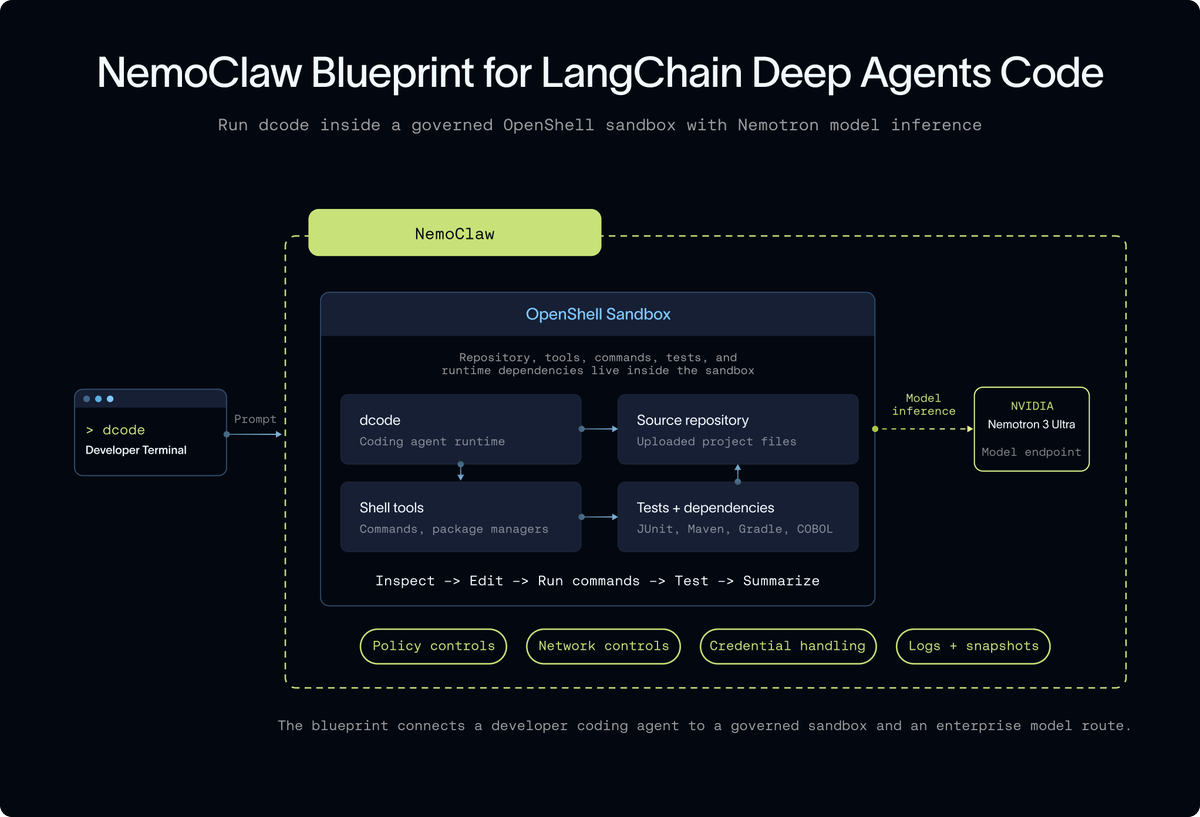
LangChain and NVIDIA introduce the NemoClaw Deep Agents blueprint
NemoClaw combines Nemotron 3 Ultra, Deep Agents Code, and the OpenShell runtime as an open enterprise-agent blueprint. It supplies configurable harnesses, sandboxed execution, policy controls, and auditability for production deployments.
X
Anthropic identifies a privileged internal Claude workspace with J-space
Anthropic's J-space technique surfaces internal representations tied to concepts a model is preparing to verbalize. Intervening on those representations impaired multi-step reasoning, while observation exposed hidden sabotage-oriented goals in a test model.
X
GitHub agent workflows can be induced to expose private repository data
Noma Security showed that a public issue could carry indirect prompt injection that causes an Agentic Workflow with broad repository-read access to post private content in a public comment. The finding highlights the risk of running issue-triggered agents with unnecessarily broad credentials.
TheHackerNews
HalluSquatting turns coding-agent hallucinations into a supply-chain attack
Researchers described adversaries registering repositories or plugins whose names match packages that coding assistants reliably invent. Indirect prompt injection can then steer an agent toward command execution from the attacker-controlled dependency.
TheHackerNews
Friendly Fire demonstrates code-review-agent command execution risk
The Friendly Fire proof of concept embeds prompt injection in untrusted repository files to induce Claude Code or Codex to execute an attacker-controlled binary during security review. The execution path depends on configurations that autonomously approve commands.
TheHackerNews
SGLang adds serving optimizations for CUDA Graphs and routed MoE
SGLang made Breakable CUDA Graph its default capture path, added decode context parallelism for MLA models and FlashInfer all-to-all for routed MoE. The release also introduced native web search support.
XBlogs
8 readsHow GitHub reduced Copilot code-review cost through workflow design
02GitHub explains why replacing code-exploration tools initially raised review cost and reduced issue detection, and how rewriting agent instructions restored quality while lowering average cost.
articleNative-speed vLLM Transformers backend
Hugging Face details how the Transformers modeling backend can serve supported models in vLLM without custom ports while matching or exceeding native implementations in tested configurations.
articleView 6 more blogs
03Weblica: reproducible web environments for training visual agents
04Weblica uses HTTP-level caching to replay interactive web states and LLM-based environment synthesis to create scalable environments for visual web-agent reinforcement learning.
articleChoosing model capability and effort in Claude Code
05Anthropic explains that Claude Code's effort setting changes tool use, file reading, verification, and task persistence as well as reasoning, helping teams distinguish effort limits from model-capability limits.
articleUsing JAX host offloading to relieve LLM training memory pressure
06NVIDIA describes moving selected activations to pinned host memory and overlapping transfers with computation, including MaxText results on large dense and mixture-of-experts models.
articleDesigning LLMs for inference hardware
07A hardware-aware guide to transformer dimensions, GPU tile alignment, quantization, expert parallelism, and the trade-off between throughput and interactivity.
articleImproving agents through trace mining
08LangChain argues that agent traces are the core dataset for continual improvement and outlines how observed behavior can feed fine-tuning data, harness changes, and memory updates.
articleHow to evaluate general-purpose robot policies for deployment
NVIDIA Research outlines RoboLab, a robot-agnostic evaluation approach with scalable task and scene generation, graded scoring, trajectory-quality measurement, failure logging, and environmental sensitivity analysis.
articleBengaluru radar
2 eventsSNIA storage meetup: S3 over RDMA for AI
□A technical Bengaluru meetup on redesigning S3-compatible object storage around RDMA transports for AI training and inference, covering GPU-memory data paths, interoperability, multitenancy, latency, and throughput.
24 Jul, 2 pm · 33 Ulsoor Road #Phase 2, Bengaluru, KA 560042DataHack Summit 2026
A Bengaluru AI conference focused on the agentic operating layer, with talks, live model-building sessions, workshops, and demonstrations of real-world AI applications.
5 Aug, 5 am · The Leela Bhartiya City Bengaluru - Hotel Conventions Residences, ThirumenahalliInbox edition
Know what matters before your day gets noisy.
Subscribe to Ekloge for one carefully curated AI briefing in your inbox—no endless feed, no filler.