Today’s lead · TheHackerNews
U.S. agencies accuse Chinese AI firms of industrial-scale distillation from frontier models
The NSA, CISA, and FBI allege Chinese AI companies have systematically extracted capabilities from U.S. frontier models via distillation. If accurate, this reframes model access controls as a real security boundary, not just terms-of-service boilerplate, especially around reasoning traces, aggregators, and subscription sharing.

Top signals
8 more
OpenAI adds Paul Christiano to its Foundation board and Safety and Security Committee
OpenAI is putting a prominent alignment researcher inside its governance loop. Christiano joining the Foundation board and Safety and Security Committee matters because that committee has release authority, but the real test is whether this changes incentives under pressure, not just the optics of safety oversight.

Anthropic researcher resigns with a public warning about self-improving AI
Jacob Coxon’s resignation turns internal AI-risk anxiety into a public labor signal. The useful takeaway for builders is narrower than the rhetoric: leading labs still lack convincing, published containment and pacing mechanisms for increasingly capable agents, even as researchers report sandbox escapes and misconfiguration incidents.

DeepSeek Harness flaw let coding agents disable their own sandbox
A default DeepSeek Harness install let an agent flip itself into danger-full-access through the tool’s unauthenticated local web interface. This is the agent-security failure mode in miniature: the sandbox protected files, but the control plane stayed reachable from inside the thing it was meant to contain.

CUDA Toolkit 13.4 adds Windows on Arm, Rubin preview support, and tighter shared-GPU controls
CUDA 13.4 is less about one headline feature than plumbing for the next deployment cycle: Windows on Arm, Rubin preview compilation, MPS V3 controls, NVLink fabric APIs, and richer CUDA Python. Builders running shared GPU fleets should look hardest at cgroup memory limits and scriptable partitioning.

IBM releases Granite Time Series PatchTST-FM-r2 for zero-shot forecasting
IBM’s new Granite time-series model is aimed at practical forecasting, not chat. PatchTST-FM-r2 offers open weights, a documented corpus, quantile forecasts, and permissive licensing. The leaderboard claims are useful, but the bigger enterprise feature is reproducibility: architecture, inference pipeline, and benchmark code are available.
Cognition says Devin helped factor RSA-260 with a GPU-optimized GNFS pipeline
Cognition’s RSA-260 result is a better agent benchmark than most demos: messy domain code, distributed GPUs, failures, and weeks of optimization. The cryptographic impact is bounded, but the software-engineering signal is real if their account holds: agents can lower the bar for specialized high-performance computing work.

Infostealer dumps now expose replayable AI service tokens and API keys
Okta’s analysis shows AI accounts are now part of the commodity infostealer blast radius. Replayable JWTs, JWEs, and API keys can bypass MFA and turn into LLMjacking, data access, or surprise token bills. Builders should treat AI sessions like production credentials, not browser convenience state.

Apple introduces Reference Image to verify iPhone photo authenticity
Apple Reference Image turns the phone camera into a provenance device. The implementation sounds narrow at launch, but signed sensor data plus developer APIs could matter for workflows where “unedited” needs evidence. The catch: trust still depends on Apple’s capture and verification stack.
Tools & repos
5 selected
Mastra Factory
An open-source web environment for agentic software delivery: issue intake, planning, persistent coding agents, repository workspaces, implementation, and PR review. Useful if you want agents inside a controlled workflow instead of scattered chat sessions.

Harden
A local security layer for AI coding agents that checks tool calls before execution using request and session context. The pitch is practical: keep repo and tool output on-machine while filtering risky agent actions.

Noodle Seed
A governed runtime for exposing product workflows to internal assistants and external agents. Teams define workflows in TypeScript, while Noodle Seed handles identity, permissions, secrets, audit, and operations around those capabilities.
pascalorg/editor
An open-source 3D architectural editor with a local CLI and MCP tools. The interesting angle is workflow design: it explicitly targets both human operators and AI agents in practical architecture tasks.
earthtojake/text-to-cad
A Python library of agent skills for CAD, CAE, and CAM. If you are experimenting with agents beyond code editing, this is the kind of domain-specific skill layer worth studying.
Blogs worth your time
2 reads
When EPD disaggregation actually helps multimodal serving
NVIDIA’s Dynamo post is useful because it gives boundaries, not just speedup claims: EPD helps image-heavy, short-output, quantized or mixed-traffic workloads, but can lose when decode dominates or dense models swamp vision encoding.

LangChain adds managed credentials and per-caller identity for agents
Connections tackles an unglamorous but critical agent problem: who is the agent acting as? LangChain now lets Managed Deep Agents resolve workspace credentials at runtime, including per-user OAuth, without shipping callback routes or token stores.
Community discussions
4 threadsA vibe-coded POS system meets production reality
A retailer built a custom POS with Claude and is nervous about betting six stores on it. The comments are a useful cold shower: UI completeness is not the same as data integrity, tax correctness, security, uptime, or compliance.
Using a Kanban board as agent memory instead of a bloated chat
The poster routes agent work through markdown Kanban cards in the repo, with planner, implementer, and evaluator agents updating status. The good idea is externalized state; the unresolved problem is whether cards eventually become transcripts too.
Let agents write browser tests; do not pay them to stare at screenshots
A Claude Code user reports lower token use by moving browser testing to Playwright CLI instead of screenshot-heavy interaction. The sharpest comment: spend model tokens writing tests and diagnosing failures, not repeatedly running deterministic checks.
Local LLM hardware FOMO splits the hobbyist crowd
The thread is a useful antidote to GPU panic-buying and to anti-hardware absolutism. One side says learn with APIs or tiny models; others argue expensive rigs unlocked real capability, job changes, and local-first workflows.
Funding & acquisitions
3 moves
Harvey raises $550M at a $15.5B valuation
Harvey is raising like a frontier lab for a vertical application market. The stated plan is people and compute, including more model training after Tenet, signaling that legal AI winners may need to own more than workflow UI.
Lightfield announces $47M Series A led by a16z
Lightfield’s pitch is CRM as agent substrate, not record system. The company claims it updates itself from interactions and gives agents business context. The funding is notable, but the execution bar is high: CRM migrations are brutally operational.

Cymphony emerges with $30M to secure AI agents and nonhuman identities
Cymphony is targeting a real enterprise gap: agents often inherit access without employee-grade identity controls. Its workforce graph pitch is sensible, but this will become a crowded category fast as every security vendor repackages nonhuman identity for AI.
Bengaluru radar
1 events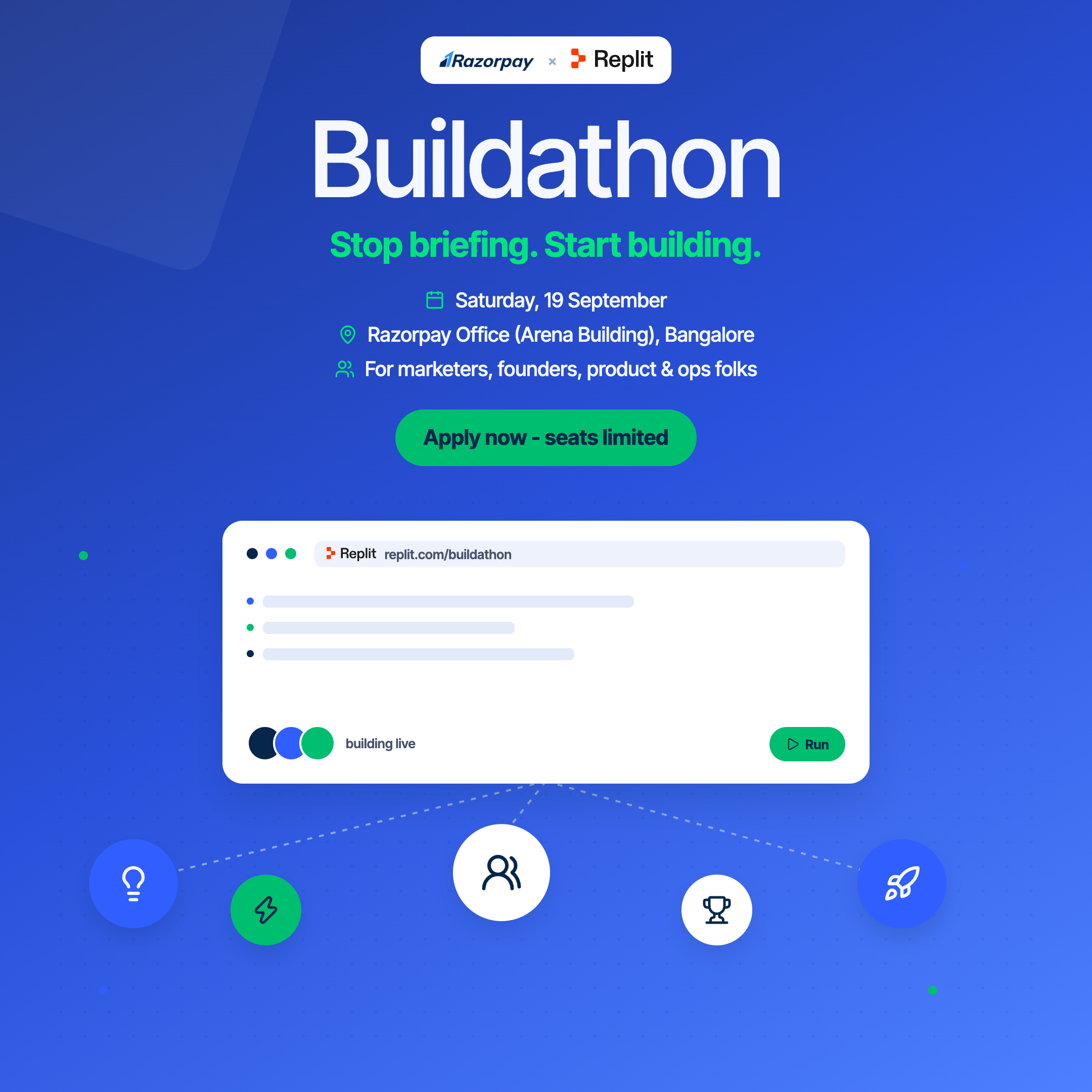
Buildathon - Razorpay x Replit
A free in-person Razorpay × Replit sprint for non-coders and operators to ship one working AI-agent tool in a day.