Today’s lead · TechCrunch
Anthropic’s Fable 5.1 aims at cheaper, longer-horizon Claude work
Anthropic released Fable 5.1 and the restricted Mythos 5.1, pitching better complex-work performance, lower token cost, and fewer false-positive safeguard blocks. The practical builder angle is privacy: Fable is available via cloud platforms and API now, while Enterprise Frontier Safeguards with client-controlled monitoring is slated for fall.

Top signals
8 more
OpenAI previews Astra, its first ‘Critical’ cybersecurity-capable model
OpenAI says Astra is its first model to hit the Preparedness Framework’s Critical cybersecurity threshold, including zero-day discovery and exploitation claims. The company is previewing safeguards before release, but TechCrunch notes key evaluation details remain unclear, so builders should treat capability and safety claims as vendor-reported for now.
Gemini gets agentic video understanding to cut long-video token burn
Google launched agentic video understanding for Gemini 3.7 Flash, 3.6 Flash, and 3.5 Flash-Lite. Instead of ingesting video at a fixed frame rate, Gemini can dynamically inspect frames, audio, and transcripts. Google claims up to 88% lower token use, 66% lower costs, and 7% accuracy gains.
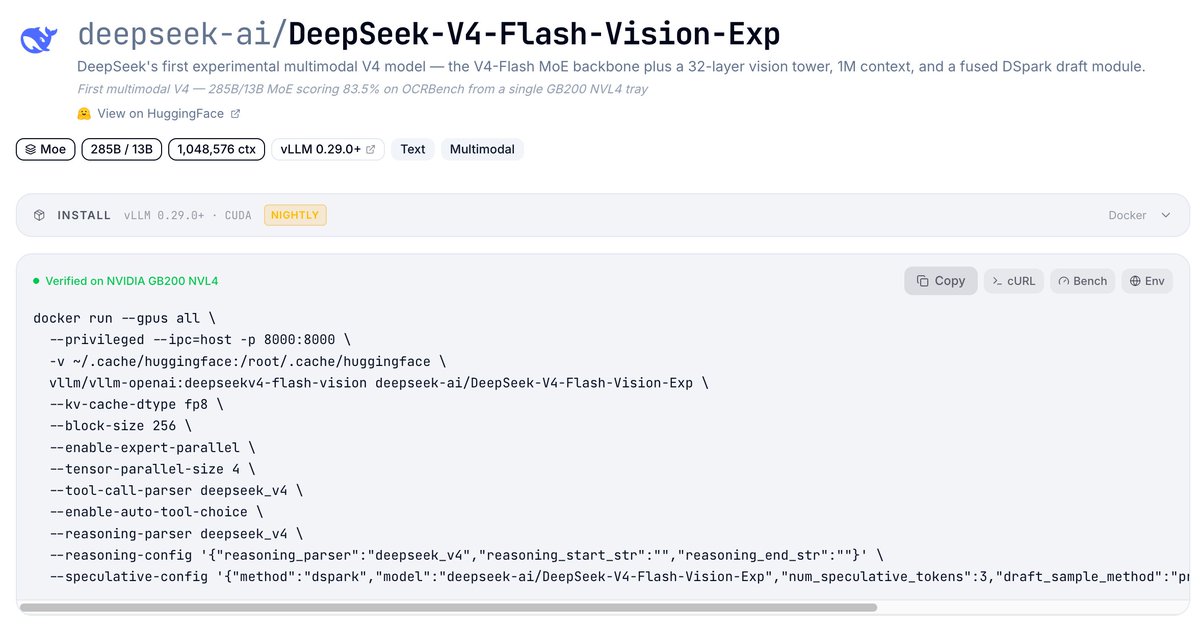
DeepSeek’s first V4 multimodal model is live, with vLLM support caveats
DeepSeek-V4-Flash-Vision-Exp is live as the V4 family’s first multimodal model, adding a vision encoder and aligner to the V4-Flash MoE backbone. vLLM says it can serve it now, but the linked guide flags that vision support is not yet in a stable vLLM release.
World Labs introduces Atlas, a camera-controlled world model for 3D scenes
World Labs announced Atlas, claiming a first-of-its-kind multimodal world model trained from scratch. The pitch is not another image generator: Atlas is described as an autoregressive diffusion model for next-frame prediction, camera-controlled video generation, novel view synthesis, sparse 3D reconstruction, and composing posed images into consistent 3D worlds.

Meta’s Muse Voice Transcribe targets real-time ASR, diarization, and endpointing
Meta launched Muse Voice Transcribe, its first real-time audio perception model from Meta Superintelligence Labs. The useful bit is the bundle: streaming ASR, diarization for 20+ speakers, endpointing, multilingual code-switching, and contextual biasing, available through Meta Model API, Meta AI for Mac, and Muse Code.

ChatGPT Health adds EHR connections, including read-only Epic access
OpenAI is connecting ChatGPT Health to healthcare data sources, including Epic EHR. For clinicians, the promise is faster chart review, timelines, medication review, and research lookup. The guardrail to notice: TechCrunch reports the Epic integration is read-only, and OpenAI says AI does not write back to records.

GuardBreaker shows malware is now targeting LLM-assisted analysis itself
ESET disclosed GuardBreaker, an adversarial prompt hidden in malware comments to trigger LLM safety refusals and derail AI-assisted triage. The specific case involved Russia-aligned UAC-0099 targeting Ukraine. For security builders, the lesson is blunt: treat file contents as hostile data, not instructions for your analyst copilot.

METR’s $600K API-key incident is a warning for agent dashboards
METR disclosed two security incidents, including a March case where a fail-open, vibe-coded agent dashboard exposed an API key and attackers burned about $600,000 worth of AI credits. The incident was not AI agents breaking evaluations; it was ordinary app security meeting uncapped model spend.
Tools & repos
4 selected
Kilo Code for JetBrains
A native, open-source coding agent for JetBrains IDEs, aimed at teams that live outside VS Code. It supports local and remote development, isolated worktree agents, inline GitHub PRs and diffs, and 500+ models.

Computable GPU Index (CGI)
CGI tracks USD price per GPU-hour from published on-demand rental rates across a fixed provider panel. Useful if you want a reproducible compute price signal instead of screenshot-driven GPU-market vibes.
browser-use/video-use
A Python repo for editing videos with coding agents. The positioning is simple but timely: move video manipulation into the same agentic coding loop developers already use for code changes.
Imbad0202/academic-research-skills
A Python repo packaging an academic research workflow for Claude Code: research, write, review, revise, and finalize. It’s a concrete example of prompt-and-process scaffolding around coding agents.
Blogs worth your time
4 reads
BenchMIRT asks what benchmark scores are actually measuring
Ai2’s BenchMIRT audits individual benchmark prompts using multidimensional item response theory. The interesting claim: scores often mix safety and reasoning signals, so smaller, better-targeted eval sets may preserve signal while being easier to interpret.

NVIDIA and CrowdStrike test a validation-first agentic cyber loop
NVIDIA and CrowdStrike describe an offensive-defensive agent system where Nemotron models generate detections only after schema checks, telemetry grounding, replay, and review. The useful pattern is less “autonomous SOC” and more bounded agents with hard validation.

A practical GPU sizing guide for inference teams trying not to overbuy
NVIDIA’s guide turns inference sizing into workload math: use case, token lengths, concurrency, cache hit rate, latency targets, and contract length. It also frames quantization, pruning, and distillation as TCO levers, not academic model-compression trivia.

Google uses deep learning to map methane plumes from EMIT satellite data
Google Research’s MAPL-EMIT applies a Swin transformer to NASA EMIT hyperspectral data for methane plume detection, quantification, and source localization. The release includes a global plume database, trained model, synthetic plumes, and inference library.
Community discussions
4 threadsAre agent-written scripts eating low-code automation?
An n8n user argues Claude/Codex now makes small automations faster as Python scripts than node graphs. The thread’s useful tension: low-code remains good for discovery, but repos, tests, logs, and review win once the workflow matters.
Claude Code users warn Fable 5.1 may need stricter prompting
A Claude Code thread highlights Fable 5.1 behavior that can waste tokens: whole-file rewrites, denser prose, premature stopping, and sequential tool calls in coding loops. Builders upgrading should treat model migration as prompt regression testing, not a free swap.
Used CMP 170HX GPUs look risky for local inference rigs
A LocalLLaMA buyer reports two CMP 170HX cards dying within two weeks and a third arriving with defective tensor cores. The thread is a reminder that cheap VRAM only pencils out if failure rates, returns, and downtime are priced in.
Personal agents that survive novelty look more like ops handoffs
A personal-agent thread asks what is worth running 24/7 after the demo glow fades. The strongest answer is incident handoff: normal monitors detect failures, then an agent gathers logs, checks dependencies, and sends a bounded Telegram summary.
Funding & acquisitions
4 moves
AIR raises $50M for security around agent skills, plug-ins, and MCPs
AIR emerged from stealth with $50 million across two seed rounds to monitor the software supply chain around enterprise agents. Its bet: skills, plug-ins, MCP servers, and add-ons need discovery, vetting, runtime enforcement, and marketplaces.

AfterQuery reportedly jumps to a $3.2B valuation five months after Series A
AfterQuery reportedly raised a round valuing the AI training-data startup at $3.2 billion, up from a $300 million valuation in April. The company trains models and agents to work through professional task patterns, not just answer questions.

Wafer AI raises a $40M Series A for the kernel mines
Wafer AI says it raised a $40 million Series A after initially planning for $18 million. The round was co-led by MarathonMP and Chemistry, with GPU and developer-infra-adjacent investors including AMD Ventures and Y Combinator participating.

Empirik launches with $21M to predict infrastructure outages before they happen
Sequoia-incubated Empirik spun out with $21 million in seed funding for an AI infrastructure engineer that tracks system changes and predicts ripple effects. It’s positioned as a change-aware layer alongside observability and AI SRE tools.
Bengaluru radar
1 events
Robotics and Physical AI showcase at The Hardware Club Bangalore
A hands-on Koramangala meetup for robotics, drones, edge AI, embedded ML, sensor fusion, and physical prototypes. Bring hardware to demo, debug, and collaborate.