Edition W2 · Weekly
The complete week, consolidated.
JUNE 30–JULY 6, 2026. Seven daily editions in one place, with related coverage combined.
Top signals
10 signals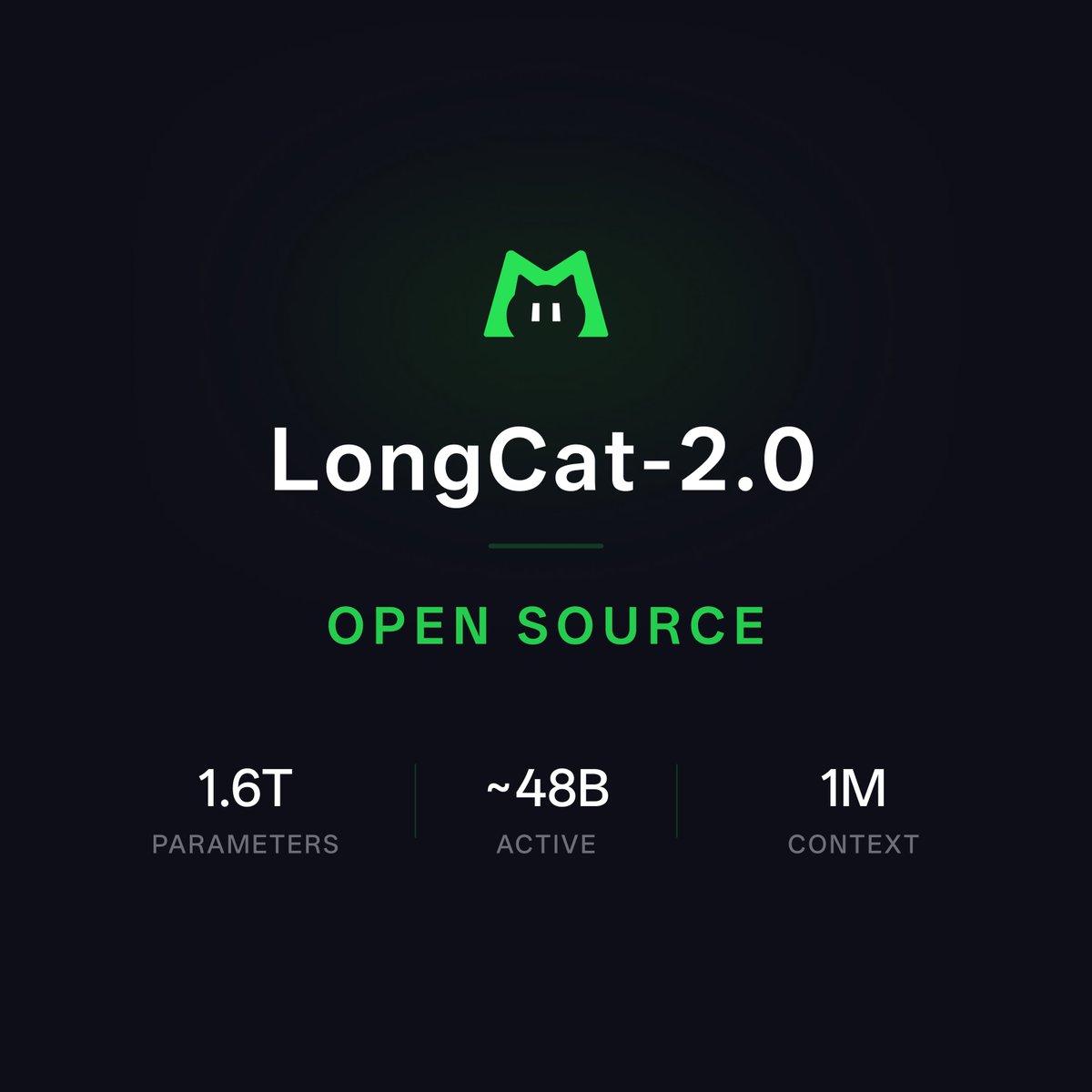
The week’s anchor
LongCat-2.0 open-sources a 1.6T-parameter MoE under MIT
Meituan LongCat released LongCat-2.0 model weights and inference code under an MIT license, describing it as a 1.6T-parameter MoE with about 48B active parameters, 1M-token context, agentic coding integrations, and GPU/NPU deployment support.
x.comRead the source →
Anthropic launches Claude Sonnet 5 and rolls it into Copilot and OpenRouter
Anthropic launched Claude Sonnet 5 as a midsize agentic model with promotional pricing of $2 per million input tokens and $10 per million output tokens through August 31. GitHub is rolling it out across Copilot plans and surfaces, while OpenRouter listed the same promo price.

Claude models become generally available in Microsoft Foundry
Anthropic said Claude Opus 4.8 and Claude Haiku 4.5 are now generally available in Microsoft Foundry, hosted on Azure with Azure-native authentication, billing, networking, governance controls, and a US data zone option.

Cloudflare sets a September 15 deadline for AI crawlers to separate search, training, and agent use
Cloudflare says that from September 15, 2026, default settings will block mixed-use crawlers from ad-supported pages for new customers, new sites from existing customers, and existing free customers unless site owners opt otherwise. It is also evolving Pay Per Crawl into Pay Per Use with initial partners Ceramic.ai and You.com.

NVIDIA introduces revenue-sharing AI factories for cloud partners
NVIDIA is partnering with AI clouds on large-scale, multi-tenant AI factories using a revenue-sharing and credit-support model. Early deployments include Sharon AI with up to 40,000 Grace Blackwell GB300 GPUs and Firmus with a Batam, Indonesia campus expected to scale to 360 megawatts and up to 170,000 NVIDIA GPUs.

Etched reports $1B in AI inference-system orders at a $5B valuation
Etched said TSMC manufactured its first transformer-specialized inference chip and that it has booked $1 billion in contract orders for full systems bundling chips, custom racks, and software. TechCrunch reports the startup has raised $800 million total, including an unannounced $500 million December round at a $5 billion post-money valuation led by Stripes.

Cursor 3.0 patches DuneSlide zero-click sandbox escapes
Cato AI Labs disclosed two Cursor flaws, CVE-2026-50548 and CVE-2026-50549, that could let a poisoned prompt delivered through MCP-connected services or web search escape the editor sandbox and run commands on a developer machine. Versions before Cursor 3.0 are affected; fixes shipped in Cursor 3.0.

Microsoft warns poisoned MCP tool descriptions can exfiltrate data through agents
Microsoft research described how attackers can hide instructions inside Model Context Protocol tool descriptions so an AI agent leaks data while each individual step still appears authorized. Microsoft recommends treating tool descriptions like system prompts, allowlisting publishers, reviewing description changes, and adding human approval for risky actions.

North Korea-linked PolinRider campaign plants 108 malicious packages and extensions
The Hacker News reports that North Korean actors tied to Contagious Interview published 108 packages and browser extensions across npm, Packagist, Go modules, and Chrome, with payloads also triggered through developer tooling such as VS Code task files. The campaign has compromised public GitHub repositories and is delivering DEV#POPPER RAT and OmniStealer variants.

Amazon will close Mechanical Turk to new customers on July 30
TechCrunch reports AWS will stop accepting new Mechanical Turk customers on July 30, 2026, while existing customers can continue using the service. AWS says it will keep investing in security and availability but does not plan new features.
Tools & repos
10 picksChromeDevTools/chrome-devtools-mcp
Chrome DevTools MCP exposes browser debugging context to coding agents, giving them a structured way to inspect pages, diagnose frontend behavior, and use DevTools signals during implementation.

TryCase
TryCase provides disposable test environments for AI coding agents, giving generated code a safe, isolated place to run and validate changes before they touch shared development or production systems.

DeepSeek DSpark in vLLM
vLLM nightly now runs DeepSeek's DSpark speculative decoding natively, using a semi-autoregressive drafter that proposes multiple tokens and verifies them in one pass. The implementation reuses SparseMLA backends, CUDA graphs, prefix caching, and FP8 KV cache.

Tabstack Browser Automation
Tabstack offers hosted browser automation for apps and agents, so teams can drive web workflows without operating their own browser fleet. It is most relevant for agent builders that need reliable web actions as infrastructure.
usestrix/strix
Strix is an open-source AI penetration-testing tool for finding and fixing application vulnerabilities. It is worth evaluating as teams move security testing earlier into agent-assisted development and pre-deploy checks.
Exa MCP
Exa's MCP exposes web search, code search, Exa Agent, and Exa Connect inside Claude, Codex, Cursor, VS Code, and other MCP clients. It gives coding and research agents a configurable search and enrichment layer without each team wiring those tools from scratch.
openai/codex-plugin-cc
OpenAI's Claude Code plugin lets users call Codex from inside Claude Code to review code or delegate tasks. It is a useful bridge for teams comparing or combining coding agents in one workflow.

Hermes MoA 2.0
Nous Research released Hermes Mixture of Agents 2.0, an open-source ensemble layer that queries models such as GPT, Claude, and DeepSeek in parallel and synthesizes a final answer. The useful signal is a configurable orchestration layer for reasoning, coding, and instruction-following tasks.
Skills Manager
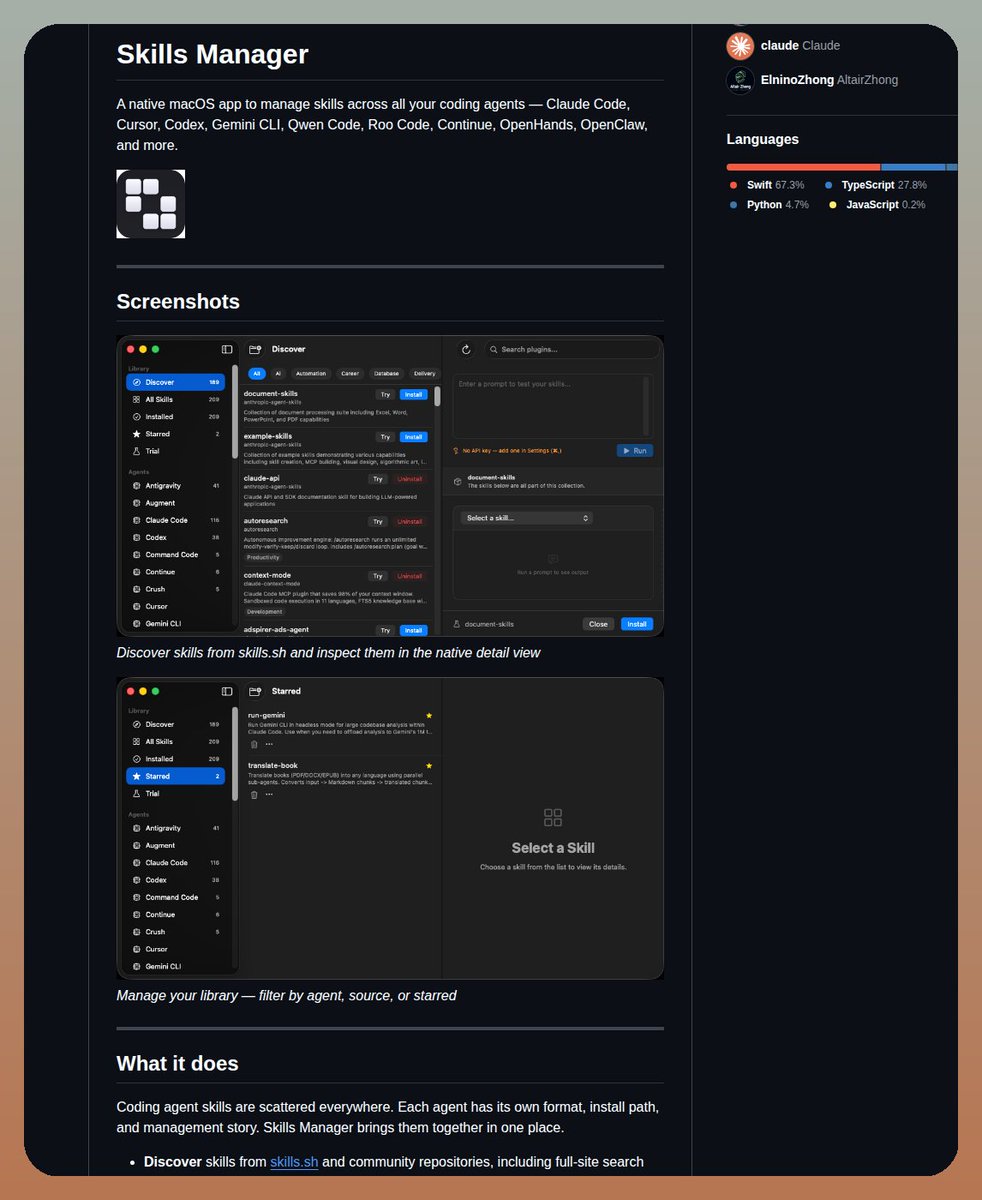
Skills Manager is a native macOS app for discovering, installing, testing, and updating agent skills across Claude Code, Cursor, Codex, Gemini CLI, Qwen Code, Roo Code, Continue, OpenHands, and other coding agents. It helps teams standardize reusable skills instead of hand-copying them across agent-specific directories.
Zackriya-Solutions/meetily
Meetily is a self-hosted, local-first AI meeting assistant for macOS and Windows, built in Rust with live Parakeet/Whisper transcription, speaker diarization, and Ollama-based summarization. It is useful for teams that want meeting notes without sending audio to a cloud service.
Blogs
10 reads
Hugging Face Kernels adds trusted publishers, signing, and a Hub repo type
Hugging Face explains the Kernels redesign: a first-class Hub repository type for native kernels, trusted publishers, reproducible builds, Git SHA provenance, Sigstore signing, Torch Stable ABI support, TVM FFI, and agent-friendly kernel-builder workflows. It is useful for teams distributing custom accelerator kernels before agents start generating more of that code.

The bottleneck moved to verification. So we automated that too.
Augment describes an internal Verifier agent that deploys each PR to an isolated live environment, exercises changed behavior, and posts logs, screenshots, API responses, and limits back to reviewers. The post is a practical blueprint for moving agentic coding from generated diffs to runtime evidence.
How to Use RLMs in Deep Agents
LangChain explains how Deep Agents uses dynamic subagents and a lightweight code interpreter to run recursive, code-driven workflows over large context instead of one turn-by-turn loop. The durable pattern is to let the model write orchestration code, then dispatch subagents for deterministic coverage across large inputs.

Hardware-Rooted AI Security That Won't Slow You Down
NVIDIA details how Blackwell confidential computing protects model weights, data, and code during inference with hardware roots of trust, NVLink encryption, and remote attestation. The useful part is the benchmark claim: Qwen 3.5 397B on HGX B300 sees mostly single-digit overhead while SGLang and FlashInfer keep secure inference close to native performance.
Your coding agent bill doubled. Here's how to fix it.
LangChain explains why multi-agent coding setups make spend hard to attribute across Claude Code, Cursor, Copilot, Codex, OpenCode, and Pi. It lays out a useful control loop: normalize traces, compare cost per session, identify wasteful tool use, and add gateway-level caps and routing.
Multi-Agent Teams Hold Experts Back
Apple researchers test self-organizing LLM teams and find they often underperform their best individual expert agent, with losses up to 41.1% on ML benchmarks. The practical warning is that adding agents can create consensus averaging unless authority is explicitly routed to the right expert.

Qwen3-Omni serving in vLLM-Omni
The vLLM team breaks Qwen3-Omni serving into Thinker, Talker, and Code2Wav stages, then shows how batching, CUDA graphs, async handoffs, and speech-stage replicas reduce first-audio latency from about 6s to about 0.6s and lift throughput roughly 5.4x under load. It is a concrete serving playbook for real-time multimodal systems.

Modern GPU Programming For MLSys
Tianqi Chen's open book builds a practical path from GPU hardware mental models to Blackwell-era kernels, using GEMM and FlashAttention examples to teach layouts, TMA, tensor cores, barriers, persistent scheduling, and warp specialization. It is useful for engineers who need to understand the performance layer beneath model serving.
Simon Willison ships sqlite-utils 4.0rc2 with Claude Fable and cross-model review
Willison walks through using Claude Fable to find release-blocking sqlite-utils transaction bugs, then using GPT-5.5 to review Fable's work and catch more edge cases. The useful pattern is concrete: let one model inspect design risk and generated docs, then use a second frontier model as a code reviewer.
Conformal Thinking: Risk Control for Reasoning on a Compute Budget
Apple and Johns Hopkins reframe adaptive reasoning as a risk-control problem: stop early when the model is confident, stop unsolvable cases before wasting tokens, and tune thresholds against a validation set. It is a useful pattern for teams trying to control reasoning cost without blindly capping token budgets.
Funding & acquisitions
8 movesMicrosoft Frontier Company
Microsoft launched Microsoft Frontier Company, an operating business focused on enterprise AI deployments using Microsoft's existing AI tools. The effort is backed by a $2.5 billion Microsoft investment and 6,000 industry and engineering experts, with early partnerships across London Stock Exchange Group, Unilever, Land O'Lakes, and Accenture.
8090 Labs
8090 Labs raised funding for Software Factory, an enterprise AI coding agent aimed at corporate programming teams with controls such as audit trails. Chamath Palihapitiya also said he will serve as CEO.
Venice AI
Venice AI raised a $65 million Series A at a $1 billion valuation. The privacy-focused AI platform says it is profitable, has over $70 million in annualized run-rate revenue, more than 3 million active users, and averages 1.7 million API calls per day.
HIVE Digital Technologies
HIVE Digital Technologies closed a US$130 million 0% exchangeable senior notes offering, bringing its total 0% coupon financing this quarter to US$245 million. The company says the capital will accelerate GPU acquisitions and expansion of its AI and HPC infrastructure platform.
Omen AI
Omen AI raised funding to build real-time fluid monitoring for data centers. Its tiny spectrometer is designed to detect coolant health issues and bacterial growth before they cause downtime in liquid-cooled AI infrastructure.
Wayve
Wayve launched an $85 million employee tender offer at an $8.5 billion valuation. The autonomous-driving startup has grown to 1,200 employees, is targeting robotaxi pilots with Uber later this year, and plans to integrate its AI software into Nissan driver-assist systems starting in 2027.
Neo
Bhavin Turakhia is self-funding Neo, a Bengaluru enterprise work platform combining project management, documents, file storage, and AI. The company says it is model-agnostic, has been in internal use since April, and plans to roll out to mid-sized businesses in technology, consulting, and professional services.
Kapture CX
Kapture CX, described by Entrackr as an agentic AI platform, raised $10 million in a pre-Series B round. The round was the strongest India AI startup financing signal included in the week's daily editions.
Bengaluru radar
8 events
DataHack Summit 2026 - India's Most Futuristic AI Conference
Analytics Vidhya's DataHack Summit returns to Bengaluru with the theme Human × AI: The Rise of the Agentic Operating Layer, featuring AI talks, live hack sessions, hands-on workshops, an AI exhibition, and networking.
AI SRE Meetup - Bangalore
A practitioner-focused meetup for SREs, platform engineers, and reliability leaders discussing AI-assisted operations through real incidents, runbooks, failures, and open discussion.
Startup World Cup 2026 Bengaluru
Pegasus Tech Ventures and CEDAT are bringing the Startup World Cup regional finale to RVITM Bengaluru. Applications close July 10, the top 10 startups are announced July 20, and the regional finale feeds into a Silicon Valley grand finale with a $1M investment prize.

Bangalore Tech Mixer and Social (Tech / AI / Data / IT)
After-work networking for Bangalore software, data, AI, cybersecurity, product, and startup people at We:Neighborhood. Useful for local hiring, referrals, and peer-network access rather than a formal talk.

AI Skills Sprint - A 4-Workshop Series for Modern Professionals
A hands-on AI workshop series for working professionals covering AI-ready use-case framing, prompt and workflow design for non-coders, AI-augmented career portfolios, and product/UX decision-making.

Startup Stories by Bengaluru Founders
Startup Foundry's community evening for hearing Bengaluru founder journeys, discussing startup challenges and breakthroughs, and meeting people building in the local ecosystem.

Founders & Investors Xplore by CEDAT
A startup ecosystem event with investor and founder talks, live startup pitching, funding insights, and networking for founders, mentors, and operators.

eChai Startup Demo Day in Bengaluru
A monthly founder demo session where early-stage product startups show what they are building, get live questions and feedback, and are listed on the event page so attendees can follow up after the room.
Inbox edition
Know what matters before your day gets noisy.
Subscribe to Ekloge for one carefully curated AI briefing in your inbox—no endless feed, no filler.