Today’s lead · X
NVIDIA Molt puts agentic RL training behind a small PyTorch-native stack
NVIDIA’s Molt is pitched as an open-source, PyTorch-native RL framework for agentic research: Ray for placement and queues, vLLM for rollout, AutoModel/FSDP2 for training. The useful bit for builders is the abstraction: rewards can be arbitrary Python, not a pretrained reward model.

Top signals
3 more
OpenAI now wants California’s SB 53 AI safety bill strengthened
OpenAI has shifted from opposing California SB 53 to asking lawmakers to add safeguards around frontier-model monitoring and cybersecurity. The reversal matters because state-level rules may become the practical baseline while federal AI legislation lags, especially after recent model-control incidents.

Inherent claims a 27B-agent beat frontier systems at paper replication
Inherent says Faraday, an AI research agent running on a 27B-parameter Qwen model, outperformed larger Anthropic and OpenAI systems at reproducing published scientific findings. Treat the benchmark as narrow, but the direction is interesting: smaller agents trained for research taste, not just raw scale.

Frontier labs still publish little about rogue-model containment
Guidelight AI Standards found few public containment protocols for leading labs if a model tries to subvert control. For teams deploying agents into real systems, the gap is operational, not philosophical: logging, permission revocation, shutdown triggers, and third-party audits are still mostly opaque.
Tools & repos
3 selected
Zero
Vercel’s experimental language is aimed at agent-written code: agents patch a semantic program graph while the compiler checks changes, with humans reviewing readable projections when needed.

Open Analytics
Open Analytics is a privacy-first Google Analytics alternative with a lightweight cookieless script, real-time funnels and revenue tracking, self-hosting, and MCP connectivity for AI tools.

KerasFormers
KerasFormers packages pretrained transformer models in pure Keras 3, with the stated goal of running across JAX, PyTorch, and TensorFlow backends.
Blogs worth your time
1 reads
Reasoning-trace leakage is becoming an agent security problem
Ilia Shumailov and Alexander Panfilov explain how encrypted reasoning blobs can be replayed into smaller models, making them disclose traces, leak private context, or carry invisible prompt injections across shared agent runs.
Community discussions
5 threadsA 60 MB scratch-trained LLM sparks the right argument: clever retrieval, not magic RAM
A builder posted a 250M model trained on 30B tokens, quantized below 2 bits and using a disk-backed long-context cache. Comments liked the hack but challenged any framing that disk and RAM are equivalent.
Agent context compaction can lower tokens and still raise the next bill
The post explains a nasty billing edge: summarizing an agent transcript may destroy prefix-cache alignment, turning cheap cache reads into costlier cache writes. The takeaway is to optimize for cache behavior, not just raw token count.
A homelab DGX Spark cluster grows to 36 nodes and 4.6 TB unified memory
A LocalLLaMA user is scaling a DGX Spark homelab from 16 to 36 nodes, framing it as a sovereign agent capability cluster rather than one inference box. Replies naturally ask about 24/7 economics.
Claude Code users are noticing that agent waits break engineering flow
A pro-AI developer says Claude Code’s prompt-wait rhythm pulls them into Reddit or HN before flow starts. The thread’s tension is familiar: parallel agents sound efficient, but real engineering still needs hands-on focus.
A possible Codex quota culprit: local Computer History logs becoming context
The post claims ChatGPT Codex quota drain may come from Computer History, not Computer Use: Skysight-generated local event logs could later be processed as context, exploding token volume without an obvious large user prompt.
Funding & acquisitions
1 moves
Zenalyst raises Rs 3 crore pre-seed for enterprise AI agents
Bengaluru-based Zenalyst raised Rs 3 crore to expand ZenForce, its enterprise AI agent platform for treasury, procurement, and legal workflows. The company claims integrations with 150+ enterprise systems and early customers in real estate, pharma, infrastructure, and travel.
Bengaluru radar
2 events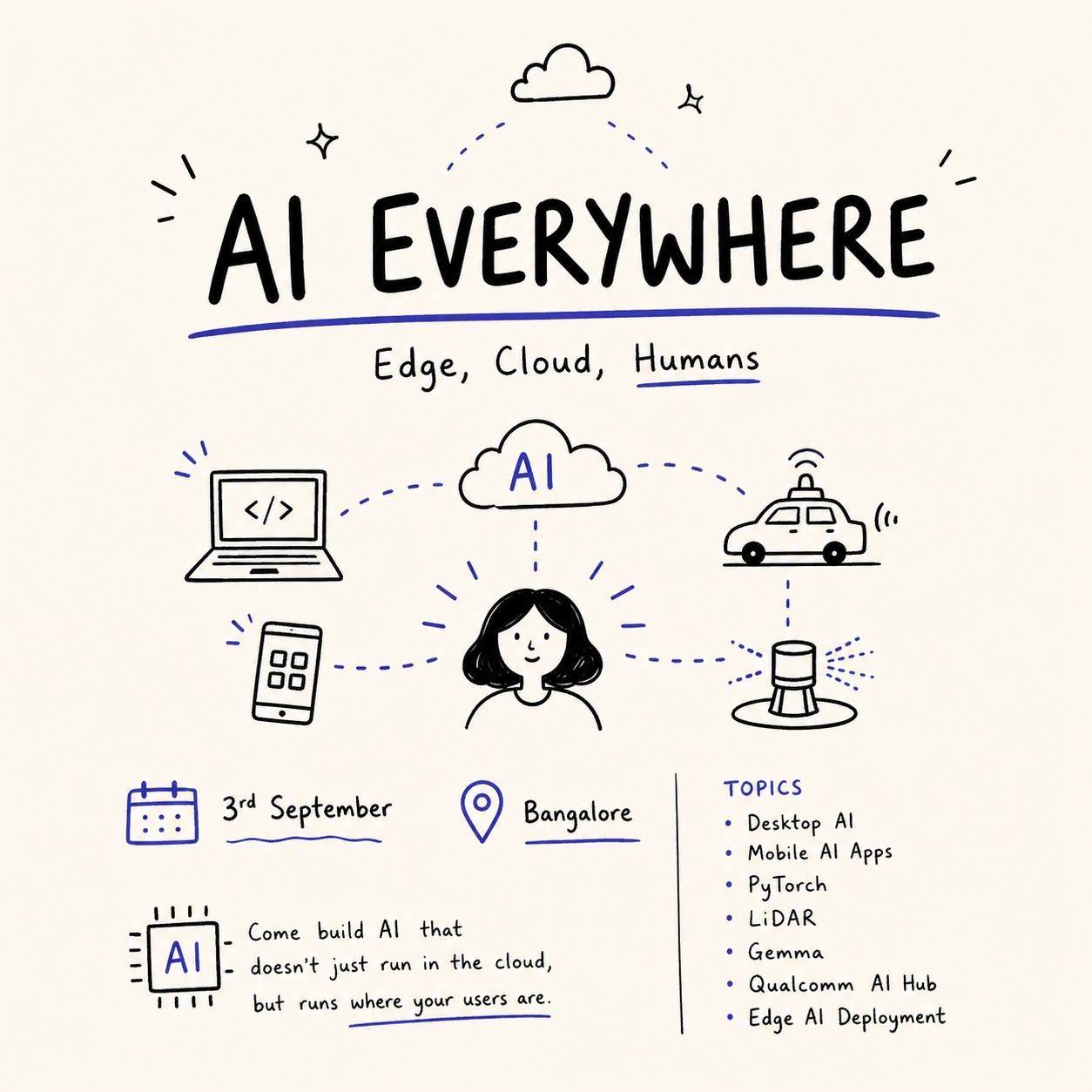
AI Everywhere: Edge, Cloud and Humans
Hands-on Bengaluru session on deploying AI across desktop, mobile, and edge using PyTorch workflows, Qualcomm AI Hub, Gemma, and device-side optimization.

Product Roast at AI House: No AI Was Harmed (Just Embarrassed)
AI House is selecting 10 GenAI founders for live two-minute product demos followed by specific, brutal, good-faith feedback from roasters.