Today’s lead · NVIDIA Technical Blog
Qwen’s 2.4T open-weight model gets day-zero serving paths
Alibaba’s Qwen3.8-2.4T-A95B is now open-weight at true data-center scale: 2.4T total parameters, 95B active per token, one-million-token context, and configurable reasoning. The practical news is day-zero serving: NVIDIA reports GB300 NVL72 throughput, while vLLM has ready FP4 paths across NVIDIA and AMD.

Top signals
5 more
Hidden reasoning blocks became a replayable secret channel
Researchers found that opaque reasoning objects from OpenAI, Anthropic, and Google APIs could be replayed across sessions and decoded by compatible weaker models. The attack is reportedly mitigated, but the builder lesson remains: sanitized visible text is not enough if raw agent traces still carry hidden reasoning blocks.

LiteLLM’s 40-minute PyPI compromise may have sprayed long-lived secrets
Malicious LiteLLM releases 1.82.7 and 1.82.8 were reportedly live on PyPI for about 40 minutes, but that was enough to harvest CI and runtime secrets at scale. Teams should treat March 24 installs, including transitive agent-framework pulls, as a rotation event rather than waiting for misuse proof.

Google brings ASL sign-to-text into Pixel typing and transcription
Google DeepMind introduced SL2T, a multilingual sign-language-to-text model now powering ASL-to-English dictation in Gboard and Live Transcribe on Pixel 11. The accessibility win is real, but Google is careful about scope: ASL first, more devices and languages later, with known errors still documented.

Liquid AI ships a 3B vision-language model aimed at edge workloads
Liquid AI’s LFM2.5-VL-3B targets the unglamorous but useful edge VLM lane: documents, screens, OCR, grounding, multi-image input, and tool calls. The supplied benchmarks show strong size-class results, and the key builder hook is deployment breadth: llama.cpp, MLX, vLLM, SGLang, ONNX, WebGPU demos, and on-device runs.

Twitch makes creator content AI-training opt-out by default
Twitch will use creator content to train generative AI models across Amazon unless streamers manually opt out. The blunt admission from CPO Mike Minton — “If this was opt-in, nobody would opt in” — says the quiet part out loud and will matter to any platform hosting creator-owned media.
Tools & repos
6 selected
Unsloth Desktop
Unsloth Desktop packages local AI running and fine-tuning into an open-source desktop app. It supports LLMs, image/video diffusion, audio, no-code fine-tuning, and connecting agents like Claude Code or Codex to a local GPU.

Dograh
Dograh pitches itself as an open-source VAPI alternative for voice agents. The useful bits are self-hosting, a visual flow builder, 30+ model integrations, local model support, telephony, human transfer, QA, monitoring, and MCP-assisted agent building.
stablyai/orca
Orca is an agent development environment for running a fleet of parallel coding agents. The repo says it works across desktop, mobile, and VPS, and lets users run agents with their own subscriptions.

BearDrive
BearDrive turns the local folder where AI agents create files into a shared, versioned team workspace. It is aimed at reports, decks, CSVs, and research produced by agents like Claude Code, Codex, Gemini CLI, and local tools.
cathrynlavery/diagram-design
diagram-design is a compact asset repo: 29 editorial diagram types for Claude Code, implemented as self-contained HTML and SVG. The positioning is opinionated: no shadows and no Mermaid-generated slop.

Click
Click is an MCP for adding live research connectors to ChatGPT and Claude. Its promise is external context from professional and social platforms, marketplaces, financials, and other sources that built-in web search may miss.
Blogs worth your time
4 reads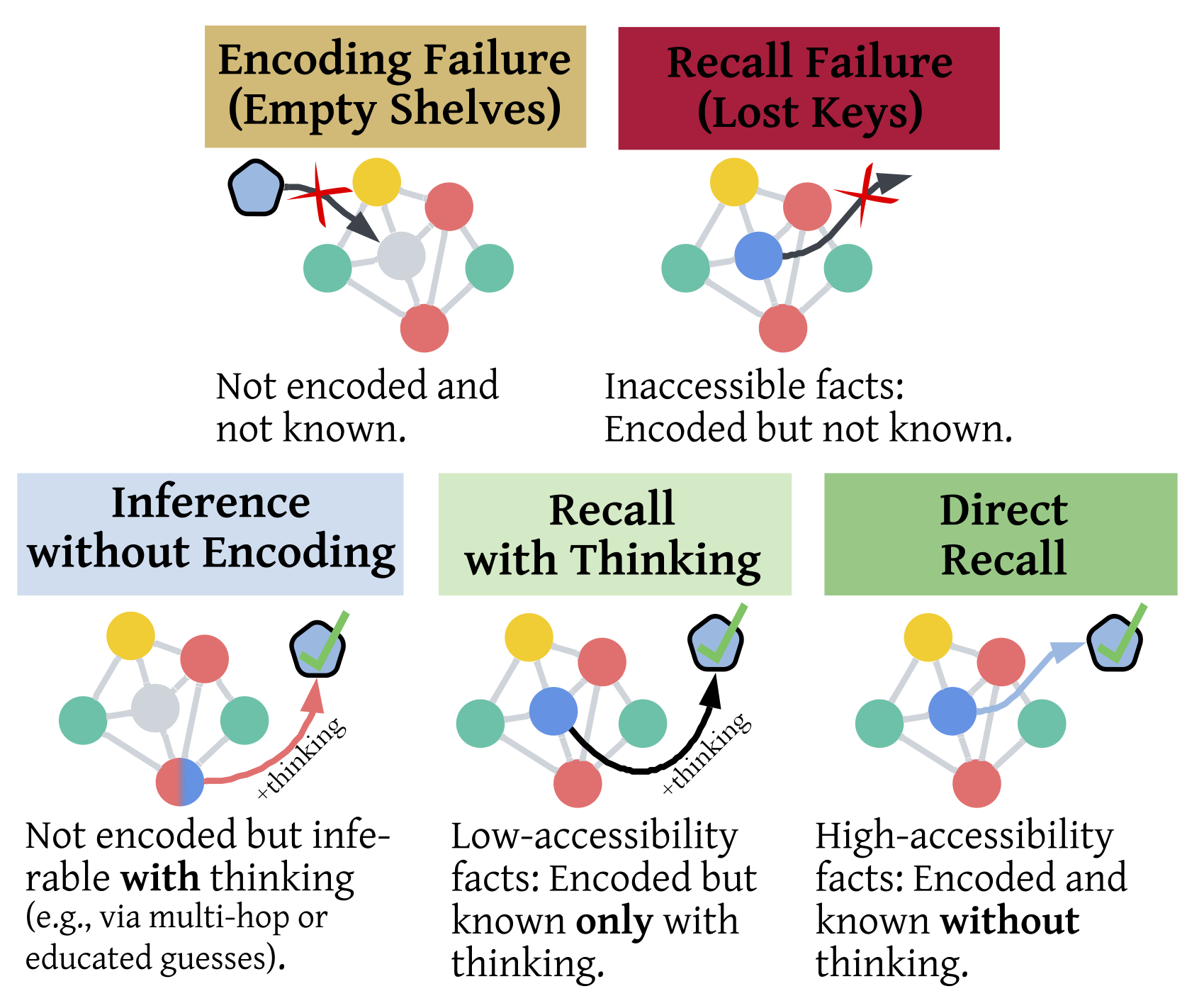
Google argues factuality is now a recall problem, not just a training-data problem
Google’s knowledge profiling work separates facts a model never encoded from facts it encoded but cannot retrieve. On WikiProfile, frontier models encode 95–98% of tested facts, yet still miss many without thinking.

MindTopo tests whether VLMs can preserve topology while acting
MindTopo is a benchmark for topological reasoning: connectivity, enclosure, order, separation, and knots. Microsoft Research says current multimodal models do better on static recognition than interactive planning, where they lose structural constraints over time.

NVIDIA’s practical guide to AI-factory observability
NVIDIA’s post is less a product pitch than an operations checklist: map failure domains first, then pick the smallest telemetry stack that catches GPU, node, fabric, job, and inference failures before they waste GPU hours.

OlmoEarth Studio now exports custom geospatial embeddings
Ai2’s OlmoEarth Studio can now compute and export custom embedding COGs for Earth-observation workflows. Builders can choose region, time range, encoder size, resolution, and imagery sources, then use the vectors for search, segmentation, change detection, or exploration.
Community discussions
5 threads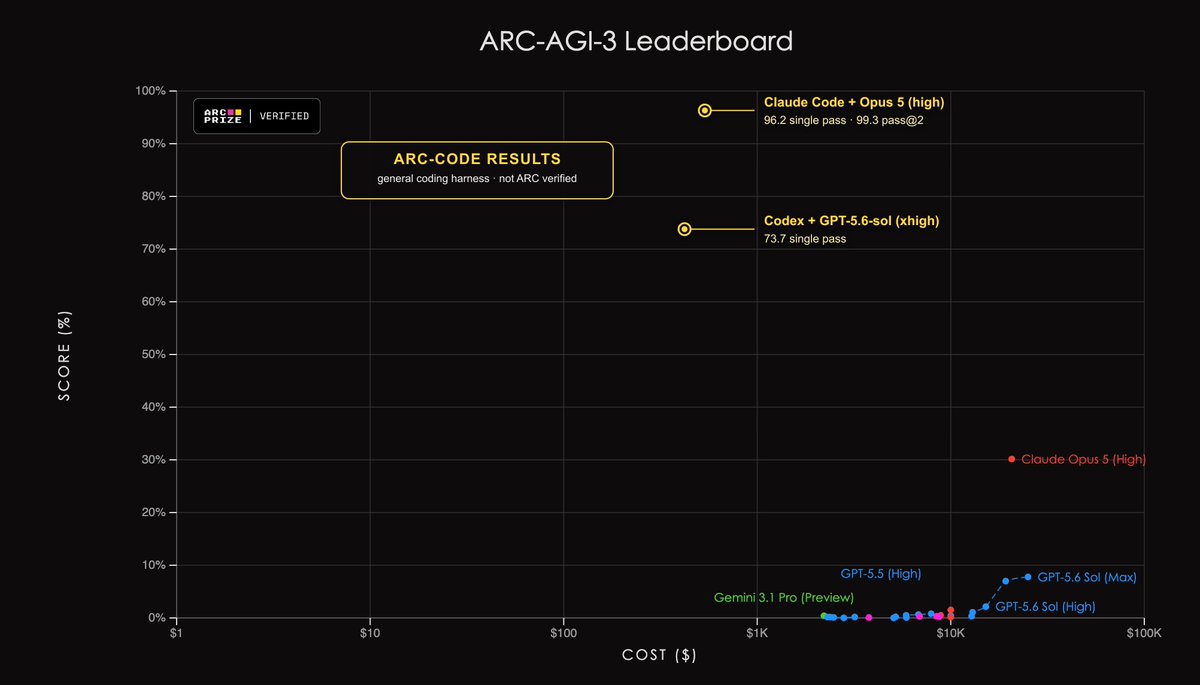
Claude Code turns ARC-AGI-3 into a test-time tool-building story
Jeremy Berman claims Opus 5 via stock Claude Code scored 96.2% on public ARC-AGI-3 games with almost no ARC-specific harness. The interesting claim is not the score alone, but that the model writes parsers, simulators, and search code per game.
Agent key leakage is becoming an ergonomics problem, not just user error
The thread asks how ordinary agent users should keep API keys away from coding agents without adopting heavyweight secret-management workflows. Commenters circle around proxies and fast rotation, but the tension is usability: safe defaults remain too hard for non-specialists.
Cursor users are treating Grok 4.6 as a cost-performance bet
Across Cursor threads, Grok 4.6 is being judged less as a prestige model and more as a cheap workhorse. Users praise backend execution and token value, but note context degradation, occasional long “deep thinks,” and stronger front-end results from Opus.
Parallel coding agents need ops-style dashboards, not more terminal tabs
A DevOps-heavy Claude Code user wants one overview for 7–10 sessions: status, project, waiting state, and current plan. The replies show the gap between worktree-centric coding workflows and infrastructure agents that jump across servers, tools, and unrelated contexts.
A daily Claude Code workflow built around isolation and distrust
The poster’s Claude Code advice is pragmatic and skeptical: Git everything, use worktrees, keep one task per chat, split brain and worker sessions, force smoke checks, and make the model write durable notes instead of trusting memory.
Funding & acquisitions
3 moves
Thrive Holdings raises $2B for AI rollups in traditional industries
Thrive Holdings raised $2B at a $12B valuation to buy traditional businesses and embed AI into their workflows. The model is closer to hands-on private equity than SaaS: accounting, IT, and now regulatory services for physical assets.

Lovable raises $400M as vibe-coding economics keep scaling
Lovable confirmed a $400M Series C at a $13.3B valuation, after reporting $500M in annualized run-rate revenue. The company says it now hosts 60M projects with 900M monthly visitors and has expanded its backend ambitions.

Blacksmith raises $45M as AI coding shifts the bottleneck to validation
Blacksmith raised a $45M Series B led by Peak XV at a $550M valuation. The thesis is straightforward: AI coding increases code volume, so CI, testing, and automated repair become the next pressure point.
Bengaluru radar
3 events
Codex Community Meetup - Bengaluru
OpenAI Codex meetup during Bengaluru Tech Week with team updates, live demos, showcase, AMA, and strict approved-entry check-in.
Bengaluru Databricks User Group - Sep 2026 Meetup
In-person Databricks meetup for Bengaluru data and AI practitioners, with community talks, product deep dives, Q&A, refreshments, and networking.

vibecoding 101 - ai & women
Women-only, beginner-friendly co-build session to use AI for idea-to-shipped project. Bring a laptop, curiosity, and optionally an idea.