Today’s lead · X
Cerebras says CS-4 doubles CS-3 speed inside the same power budget
Cerebras is positioning CS-4 as a direct capacity-and-throughput upgrade: up to 2x faster than CS-3 and up to 10x more token capacity, while staying in the same power budget. Useful signal for operators, but the dossier only gives company-side claims, not independent benchmarks.

Top signals
8 moreOrnith-1.5 shows the local-agent bar moving onto consumer GPUs
A user reports running Ornith-1.5-35B Q4_K_M on a single RTX 3060 with 12GB VRAM, 170K context, and roughly 53 tok/s decode. The quoted release claims MIT-licensed open weights across 9B, 35B MoE, and 397B MoE variants, but benchmarks are still promised, not shown here.

OpenAI keeps Zero Data Retention for frontier models and previews cross-session safety monitoring
OpenAI says eligible API customers will keep Zero Data Retention for frontier models while it previews Private Safety Processing. The practical change is long-horizon misuse detection across related interactions without personnel seeing underlying content. The hard part for buyers: validating that privacy boundary operationally, not just accepting the architecture pitch.

OpenAI is turning the Codex harness into an embeddable agent runtime
OpenAI’s developer post frames Codex less as an app and more as reusable agent infrastructure. The open-source harness manages state, streaming, tools, sandbox and approval policies, while apps own UI, context, and boundaries. That is useful if your product needs an agent loop but not another generic chat surface.

Cursor launches Origin, a Git forge built around coding agents
Origin moves Cursor closer to owning the whole agentic development loop, not just the editor. It adds code hosting, repo creation, code search, pull request review, access management, and GitHub sync. The bet is clear: if agents are writing code, the forge becomes part of the agent workspace.
Replit adds Free Mode powered by OpenAI’s GPT-5.6 Luna
Replit is introducing Free Mode with OpenAI’s GPT-5.6 Luna, aiming to remove token-cost anxiety from turning ideas into working software. The interesting product move is pricing and access, not just model capability: Replit is trying to make agentic coding feel free at the point of use.
NVIDIA shows Cosmos 3 Edge as an on-robot policy backbone
NVIDIA’s tutorial is a practical robotics deployment story: post-train a 4B Cosmos 3 Edge model, serve it on Jetson Thor, and run receding-horizon control without a data-center GPU. The caveat is compute: the validated post-training run used 64 nodes of 4x GB200 for about 68 hours.
Raon-OpenTTS-1B brings open-weight zero-shot voice cloning into sharper focus
Raon-OpenTTS-1B is presented as an open-data, open-weight zero-shot TTS model trained on large curated English speech data. The reported numbers are strong on WER and speaker similarity, including noisy and expressive conditions. For builders, the useful angle is reproducibility; the risk is still voice-cloning misuse.

Liquid AI releases QAD Q4_0 GGUFs for LFM2.5 edge models
Liquid AI released QAD Q4_0 GGUF checkpoints for four LFM2.5 models, targeting the annoying edge tradeoff between Q4 memory and quality loss. They claim roughly 97% BF16 accuracy retention and real throughput wins on laptops, mini PCs, phones, and Raspberry Pi-class hardware.
Tools & repos
5 selected
Clipto MCP
Clipto MCP gives Claude, ChatGPT, and other agents access to local videos, photos, and audio. The useful bit is media retrieval from your own files: rough cuts, script-to-footage matching, and topic search without manually scrubbing terabytes.
obra/superpowers
Superpowers is an agentic skills framework and software development methodology. The repository is trending hard, which says the “skills” packaging pattern is resonating with builders trying to make agents more repeatable.
mattpocock/skills
Matt Pocock’s skills repo is a public slice of his .agents directory. Treat it less as a framework and more as field notes on how experienced engineers are structuring reusable agent instructions.

Claude Watermark Remover
This browser tool finds concrete text artifacts like hidden classes, zero-width characters, exotic spaces, and typography leftovers. Importantly, it does not claim to detect Anthropic’s statistical watermark; it focuses on byte-level traces it can actually show.
harry0703/MoneyPrinterTurbo
MoneyPrinterTurbo is an AI video-generation workflow for creating HD short videos from a topic or keyword. Its trending velocity shows ongoing demand for automated content pipelines, even if production quality still depends on the workflow details.
Blogs worth your time
3 reads
NVIDIA SkillEvaluator puts numbers behind agent “skills”
NVIDIA’s useful contribution is not another agent recipe; it is an evaluation harness. SkillEvaluator compares runs with and without a skill, then measures correctness, discoverability, effectiveness, efficiency, and security.

NVIDIA FLARE’s practical guide to federated multimodal training
This is a systems post for teams that cannot centralize multimodal data. The key design questions are what model state crosses the network, and how to stream or aggregate it without blowing up memory.
Simon Willison on why coding agents make conceptual integrity harder
Willison’s argument is a useful correction to “agents replace teams.” Agents can raise code throughput, but the bottleneck moves to human cognitive capacity and preserving a coherent architecture.
Community discussions
5 threadsAgent auditability means logging the decision environment, not just the action
The thread’s concrete lesson: an action log is not an audit trail. Builders point to point-in-time policy versions, RBAC, prompt versions, tool manifests, and contemporaneous records as the minimum needed to explain why an agent was allowed to act.
Sandboxing coding agents is a UX problem as much as a security problem
A Claude Code cleanup command deleted half an Obsidian vault, sparking a practical sandboxing thread. The tension is familiar: full VMs protect files but wreck workflow continuity; tool-level sandboxing preserves memory and config but needs careful destructive-command controls.
LangGraph’s remaining job is deterministic orchestration, not demo magic
The thread asks whether LangGraph still matters as model providers ship managed agent loops. The best answer: own orchestration only when explicit state, retries, branching, approvals, observability, or provider independence are part of your product’s value.
Multi-agent systems still look easier on diagrams than in production
This thread pushes back on multi-agent hype. The useful distinction from commenters: multiple agents can make sense when roles, prompts, tools, and responsibilities are genuinely distinct; otherwise coordination overhead may be worse than the original task.
An autonomous Claude experiment earns more trust by publishing its limits
The interesting part is not the stunt; it is the operating pattern. The agent logs boundaries, money movement, refusals, stale-memory failures, and product pivots publicly. Commenters still press on cost, product value, marketing, and real-world delegation.
Funding & acquisitions
3 moves
Rillet raises $100M Series C at a $1B valuation
Rillet’s Series C is another sign investors still believe AI can unseat legacy ERP and accounting software. The company claims over 600 customers and doubled ARR in three months; useful traction signals, though valuation heat is doing plenty of work here.
CtrlS raises Rs 250 crore for India data centre expansion
CtrlS is raising growth capital into the obvious bottleneck: AI, cloud, and enterprise workloads need physical data centre capacity. Nikhil Kamath put in Rs 200 crore, with Sreeram Reddy Vanga adding Rs 50 crore.
idler launches with a $9M seed round for frontier data research
idler is entering the picks-and-shovels layer for frontier labs: evals, benchmarks, and reinforcement learning environments. The company says Paradigm led its $9M seed, with YC, Long Journey VC, and several angels participating.
Bengaluru radar
2 events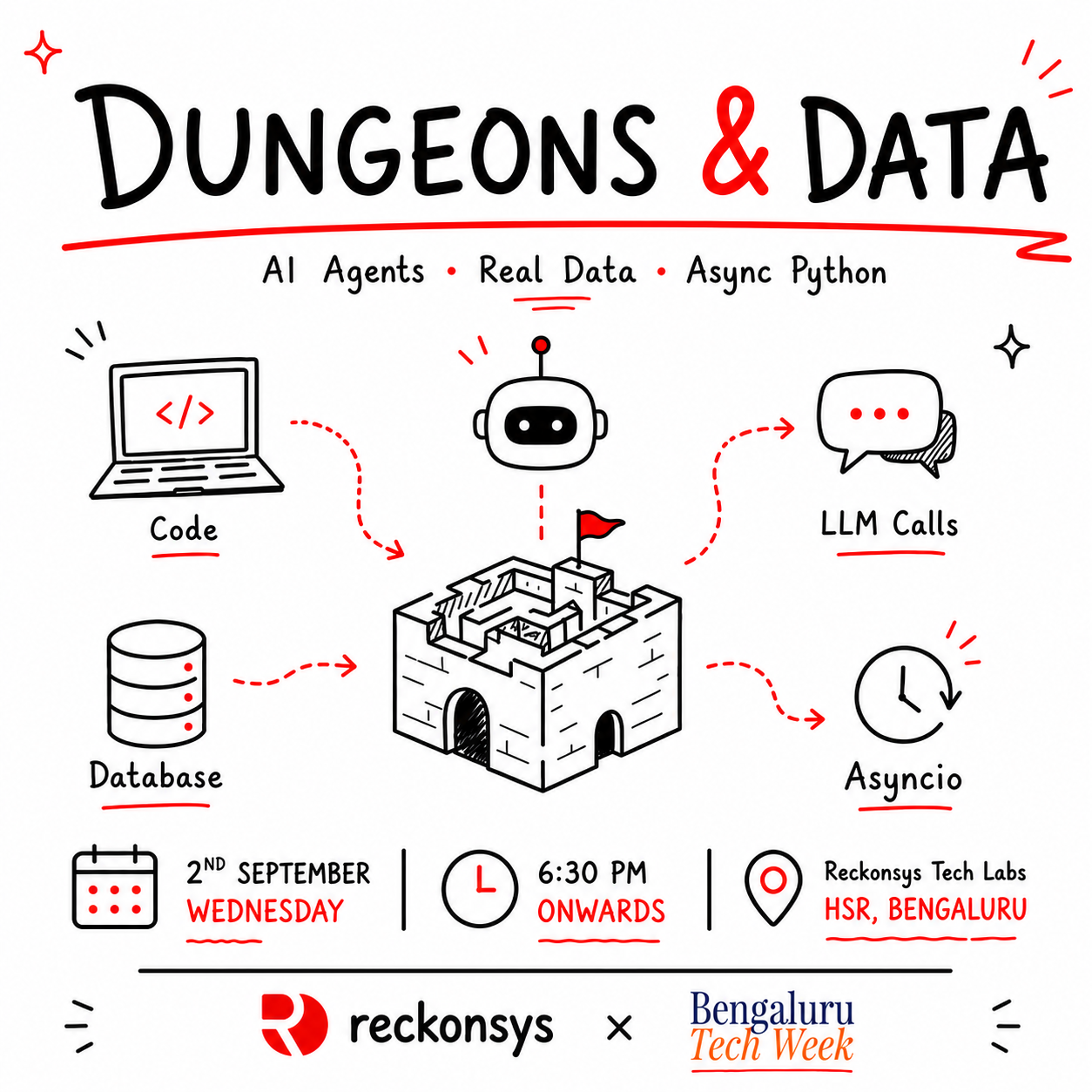
Dungeons and Data
Hands-on Bengaluru Tech Week session on agents over DocumentDB/Postgres, then practical asyncio patterns for Python AI workflows.

AIBoomi Expert Hours with Shekhar Kirani
Curated Koramangala session with Accel’s Shekhar Kirani on building AI-native companies from first principles. Only 23 spots.