Today’s lead · X
Google Cloud and Inferact put TPU on the vLLM roadmap
Google Cloud and Inferact say they are aligning on one engineering roadmap to make TPU a first-class vLLM target. For builders, the practical promise is less hardware-specific glue: production serving features, optimized kernels, TorchTPU, broader model coverage, and open-source upstreaming.

Top signals
4 more
Microsoft publishes a model-level AI code of conduct
Microsoft’s new AI code of conduct turns broad alignment language into explicit model constraints, including bans on cyberattacks, nuclear weapons help, deepfakes, and evasive loss of human control. It is a governance artifact, not proof of safety, but it shows how labs are operationalizing red lines.

iOS 27 finally makes Siri feel like an AI-native assistant
TechCrunch’s iOS 27 hands-on says Siri can now handle multistep requests, on-screen context, file and message lookups, camera queries, and chat history. The useful shift is not just smarter answers; it is Siri becoming an OS-level interface across notes, apps, camera, and Apple Intelligence workflows.

SemiAnalysis claims early Rubin NVL72 agentic inference numbers beat Blackwell hard
SemiAnalysis says its AgentX benchmark shows Vera Rubin NVL72 delivering up to 7x better token throughput per megawatt than Blackwell on early software, and estimates over 2x profit per gigawatt. Treat the headline multiples as benchmark-specific, but the co-design story matters for inference economics.

404 Media reports human contractors review real ChatGPT chats
404 Media reports OpenAI uses hundreds of contractors to review real ChatGPT prompts and responses, sometimes including sensitive personal information. OpenAI says it tries to remove personal information, but acknowledged sensitive details can pass through. Builders should assume human review is part of model improvement workflows unless clearly disabled.
Tools & repos
5 selectedalibaba/open-code-review
Alibaba’s code review tool mixes deterministic pipelines with an LLM agent, aiming for precise line-level comments plus built-in rules for NPEs, thread safety, XSS, and SQL injection.
debpalash/VoiceStudio
VoiceStudio is a fully local, open-source voice workspace for cloning, design, dubbing, dictation, transcription, and audiobook creation, with the project claiming support across 646 languages.

Elva
Elva turns APIs into agent-consumable surfaces: it discovers APIs from code, lets teams control audience access, runs MCP servers with auth, and tracks agent activity and changes.

Web Search Agents by Nimble
Nimble’s Web Search Agents are positioned for domain-specific web research and crawling, with self-learning behavior for use cases like company enrichment and regulations research where generic search context is too shallow.

Oats
Oats is a local-first meeting notetaker for macOS and Windows, pitching no bots, no subscription when run locally, and optional cloud-backed transcription, coaching, follow-up tracking, and speaker features.
Blogs worth your time
4 reads
NVIDIA shows where dropless MoE training actually gets expensive
A useful deep dive if you train MoE models: NVIDIA attributes a 10.4x DeepSeek-V3 throughput gain to grouped GEMM, NCCL EP, MXFP8 quantization, host offloading, and XLA multistreaming.

LangChain’s enterprise agent lesson: platforms beat isolated demos
This is vendor-written, but the patterns are practical: Schneider, Vodafone, and monday.com converged on observability, evals, permissions, subagents, sandboxes, and shared platforms before expanding agent autonomy.

Pavan Muddireddy makes the case that speech recognition is still unsolved
The Mistral audio lead walks through Voxtral, streaming ASR, diarization, TTS, DPO for hallucination control, and why enterprise voice stacks still need cascades, adaptation, and observability.

Sebastian Raschka argues AI pacing is release governance, not a training halt
Raschka’s short post cuts through a loaded term: he reads “pacing” as formal release checks that reduce competitive pressure, not companies slowing model training or development.
Community discussions
3 threadsClaude Code users are still arguing over what “high-bar” AI coding means
A senior engineer asks for a real workflow, not vibes: code they understand, defensible diffs, and reviewable PRs. The replies mostly reinforce that agent coding needs custom harnesses and standards.
r/MachineLearning fights over whether weak research agents disprove RSI
The thread turns on interpretation: OP says agents failing to reproduce unpublished NeurIPS work undercuts recursive self-improvement; commenters push back that failure today does not settle scaling or verification economics.
LocalLLaMA debates whether “slow down AI” is safety, marketing, or capture
The open-source crowd is split but skeptical: the OP frames AI takeover talk as marketing, while replies range from “legitimate paranoia” to “bad actors won’t slow down.”
Funding & acquisitions
5 moves
OpenAI reportedly buys Glass Imaging for over $300M
If confirmed, OpenAI is buying AI camera expertise, not just another app team. Glass Imaging uses neural networks to improve smartphone images at capture time, useful context amid OpenAI hardware rumors.

Cornelis raises $205M for open AI networking fabric
Cornelis is attacking a real bottleneck: GPU time lost waiting for data. The pitch is an open networking fabric that lets customers mix accelerators instead of defaulting to NVIDIA’s full stack.

Superhuman acquires Fathom to make meetings feed agentic work
Superhuman chose acquisition over building after testing a notetaker internally. The strategic point is clear: meeting context can trigger emails, data updates, follow-ups, and agents across its productivity suite.
Nuance Labs raises $50M Series A for full-duplex emotional AI
Nuance Labs is pitching a single full-duplex audio-visual foundation model that can see, listen, and respond in real time. The money says investors still want more human-like interfaces.

Robocurve raises $10M seed for physical-world frontier AI evaluation
Robocurve is positioning itself as an independent evaluator for robotics AI, with an open-source harness and public benchmarks. The traction claims are early, but independent physical-world evals are needed.
Bengaluru radar
1 events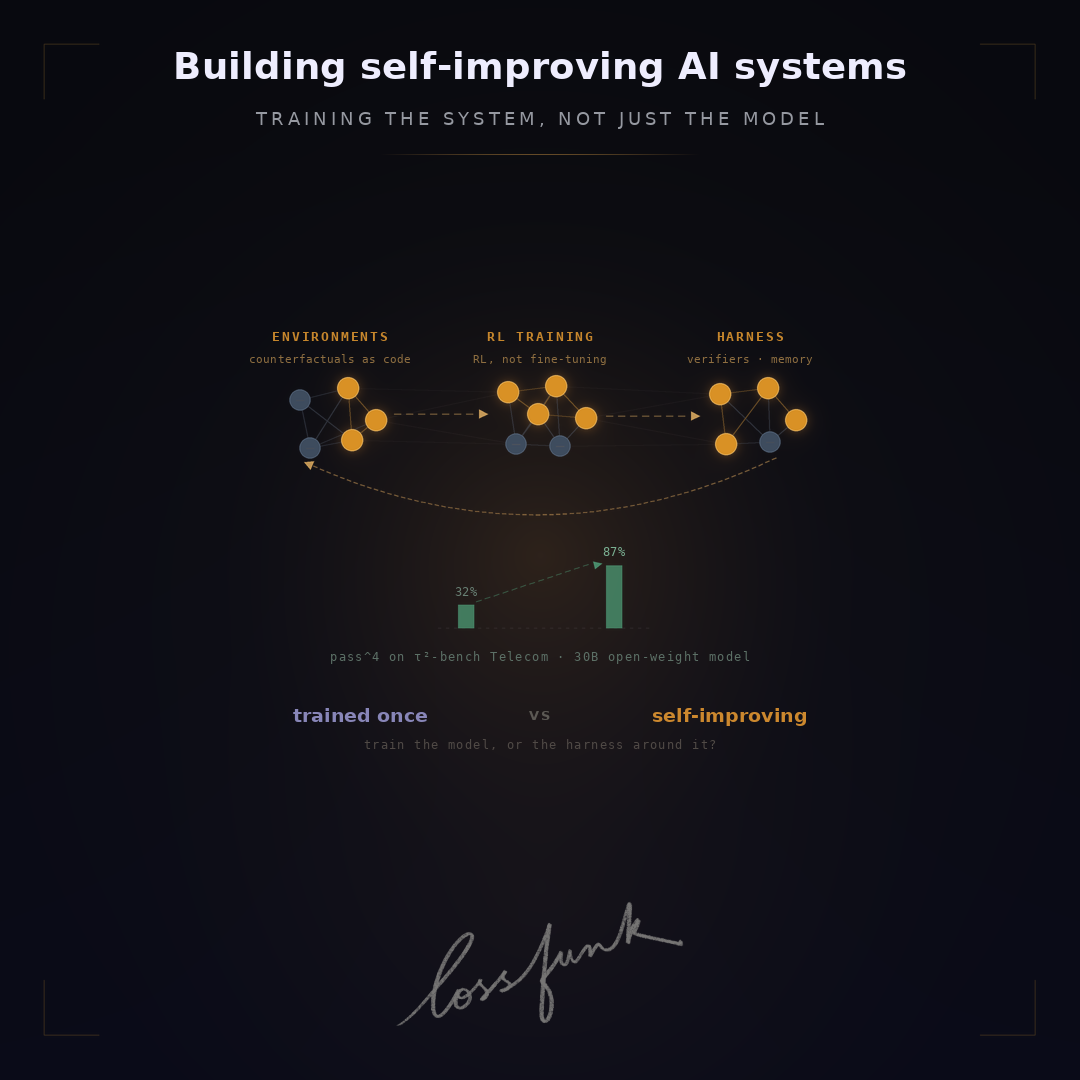
Building self-improving AI systems
In-person Bengaluru talk by Amit Sharma on environment generation, RL training, harness evolution, verifiers, memory, and self-improving AI systems.