Today’s lead · OpenAI News
OpenAI makes GPT-6 cheaper to use with Sol, Luna, and caching upgrades
OpenAI is broadening GPT-6 beyond Astra with Sol for harder coding-style work and Luna for high-volume clerical tasks. The practical hook is cost: TechCrunch reports API pricing at half the 5.6 Sol/Luna tier, backed by improved caching controls and diagnostics.

Top signals
5 more
Anthropic cuts Opus pricing while claiming Fable-level performance
Anthropic released Claude Opus 5.5 with claimed gains in coding, knowledge work, and computer use, plus lower token prices. The interesting builder signal is not just benchmark positioning: OpenRouter lists 1M context and $4/M input, $20/M output, making Opus less exotic for agent workloads.
DigitalOcean turns agent sandboxes into a managed cloud primitive
DigitalOcean Managed Agents is in public preview, aiming at the plumbing most teams keep rebuilding: persistent sessions, sandboxes, governed tool access, and billing tied to active CPU. It supports existing stacks like Claude Code, Codex, OpenCode, LangGraph, or custom OCI containers rather than forcing a new harness.

Qualcomm pushes local phone agents with Snapdragon 8 Elite Gen 6
Qualcomm announced Snapdragon 8 Elite Gen 6 and 8 Elite Extreme Gen 6, with on-device AI as the selling point. The Extreme chip can run a 30B MoE model locally, while new sensing hubs handle smaller models for local memory, speaker differentiation, and voice-agent features.

Bifrost AI Gateway RCE shows why agent control planes need auth by default
A critical Bifrost vulnerability lets unauthenticated attackers execute commands through the AI gateway’s management API when auth is disabled, the default. For builders centralizing LLM keys and MCP clients behind gateways, this is a direct reminder: management endpoints are production attack surface, not admin convenience.

Microsoft disrupts EvilTokens, an AI-assisted phishing-as-a-service platform
Microsoft says it helped take down EvilTokens, a device-code phishing service tied to 12,000 Microsoft account compromises. The AI angle matters because the service packaged mailbox analysis, target selection, and fraud-draft generation into a commercial workflow, lowering the skill bar for BEC attacks.
Tools & repos
4 selectedgoogle/ax
Google’s open agentic orchestration runtime is spiking hard on GitHub. Worth a look if you are standardizing how agents plan, call tools, and coordinate work in Go-based infrastructure.
dream-num/univer
Univer is pitching an “Office Harness for AI Agents”: spreadsheets, docs, slides, canvas, relational tables, and PDF in one runtime. That is exactly the messy surface enterprise agents need to manipulate.
davila7/claude-code-templates
A Python CLI for configuring and monitoring Claude Code. The star count suggests teams are still hungry for lightweight scaffolding around coding agents, not just heavier IDE integrations.
browser-use/video-use
video-use aims to let coding agents edit videos. It is early to judge from the dossier alone, but the direction is useful: agents need artifact-native workflows beyond code and text.
Blogs worth your time
5 reads
OpenRouter’s pragmatic shortlist for embedding models in 2026
Useful because it separates shortlist from proof: OpenRouter verified API behavior, context, dimensions, and pricing, but explicitly says retrieval quality still needs your own labeled evals before re-indexing.
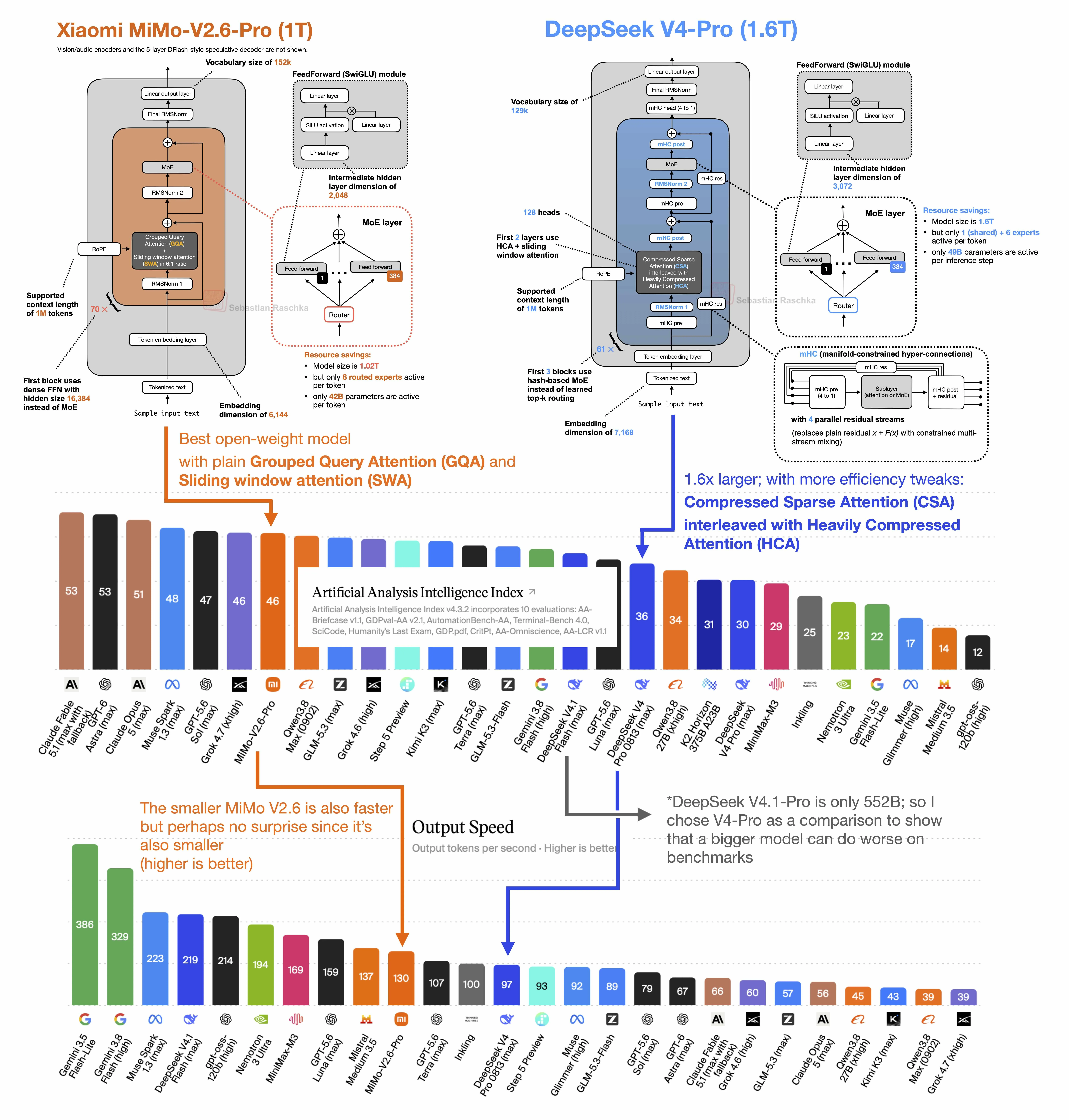
Sebastian Raschka reads MiMo-V2.6 Pro as a post-training story
Raschka’s note argues MiMo-V2.6 Pro’s benchmark strength comes less from exotic architecture and more from data and post-training: agent tasks, agentic graders, and very large RL batches.

NVIDIA shows the real overhead of confidential inference on B200s
The useful bit is the measurement method: hold workload and stack constant, toggle confidential compute, and quantify throughput retained and TPOT overhead. NVIDIA reports over 96% throughput retained for its tested DeepSeek-R1 setup.

LangChain frames healthcare AI reliability as reusable clinical judgment
This is a concrete evals piece, not generic healthcare AI cheerleading. It explains how Abridge and Included Health turn clinician review into datasets, calibrated evaluators, annotation queues, and release gates.

NVIDIA uses an AI agent to migrate ROS 2 nodes onto CUDA-backed buffers
A solid systems tutorial: the agent is not magic, it audits data movement, plans a minimal refactor, and verifies CUDA transport. The payoff is avoiding ROS boundary copies while preserving standard messages.
Community discussions
4 threadsAgent-ready SaaS starts with boring APIs, not a model glued to the UI
The thread’s useful warning: “AI-enabled” does not mean operable by agents. The author says they first built versioned APIs, auth gates, SDKs, docs, and narrow MCP tools before allowing writes in a live adtech system.
Data pipelines may be the gym for enterprise agent builders
The claim is that long-horizon data work forces the same muscles enterprise agents need: expert-agent interfaces, eval design, QC cost control, and knowing where models fail. It is a strong operator view, not neutral research.

A local-LLM power user argues EXL3 is more than another quant format
The post is opinionated and benchmark-heavy: EXL3 is framed as trellis-based compression that preserves quality better than rounding quants, with recipes by VRAM tier. Treat the numbers as user-reported, not lab-verified.
LocalLLaMA weighs Unsloth Studio against LM Studio, and install friction shows up fast
The thread captures a real local-AI tradeoff: Unsloth Studio gets credit for being open source, but commenters report Python environment damage and Windows GPU detection problems where LM Studio still works.
Funding & acquisitions
2 moves
Snorkel AI raises $350M Series E at a $3.5B valuation
Snorkel’s round is another signal that training data has become model-lab infrastructure. The nuance: TechCrunch notes headline annualized revenue figures in this market can differ sharply from net revenue because expert payouts are substantial.

Sol Foundry exits stealth with $4M for proactive email agents
Sol is betting inbox agents should act from commitments users already made, not wait for prompts. The trust boundary is sensible on paper: it drafts, researches, schedules, and prepares work, but users approve before anything is sent or shared.
Bengaluru radar
0 eventsThere are no relevant Bengaluru events to highlight today.