Today’s lead · TechCrunch
Google turns Gemini into a workplace agent with its own identity
Google is moving Gemini from chat toward delegated work: planning, subagents, app access, audit trails, and a Workspace identity with email. The business-first rollout is sensible given security and governance risk, but builders should watch how well the cross-app permissions and model routing hold up in real workflows.

Top signals
9 more
Anthropic launches a cyber mission for critical infrastructure and open source
Anthropic is packaging Claude, engineers, threat research, and free OSS scanning into a long-term cyber program. The useful bit is aimed at under-resourced defenders; the hard part is whether model-assisted vulnerability finding can reduce risk, not just increase noisy findings that humans still must verify.
Windows ML adds experimental llama.cpp and GGUF support
Microsoft is making local Windows inference less ONNX-only by adding experimental llama.cpp/GGUF support to Windows ML. For builders shipping desktop AI, the practical win is one stack that can target GPUs, NPUs, and CPUs while still experimenting with Hugging Face-style GGUF models.
Celeris ships a low-latency decision model, with benchmark caveats attached
Celeris-1-decision targets a narrow but useful job: typed yes/no, choice, and score decisions with probabilities. The company reports strong latency and calibration on its benchmarks, but builders should treat this as a specialist API to test against their own thresholds, not a general reasoning replacement.

Goodfire’s activation monitors try to catch agent misbehavior before text review
Goodfire is pitching internal activation probes as a cheaper safety layer for long-running agents, initially through Baseten. The idea is attractive for inference providers running open models: monitor the computation already happening, escalate only suspicious behavior, and avoid paying another model to read every token.

vLLM 0.31.0 focuses on faster restarts, scheduling, and large-scale serving
vLLM’s 0.31.0 release is mostly operator-grade plumbing: preload to keep weights resident across restarts, speculative decoding work, large-scale serving backends, and scheduler controls. If you run serious inference fleets, these changes matter more than a flashy demo because they target uptime, throughput, and deadlock pain.

An open AI pentesting agent shows up in real data theft attacks
CrowdStrike says ARTEX, an open-source agentic pentesting tool, was used in attacks on South Korean financial organizations. The builder takeaway is uncomfortable: publishing capable security automation changes the threat surface fast, and “research only” labels do not stop financially motivated operators from wiring agents into campaigns.

DeLM swaps the boss agent for shared context and a task queue
DeLM is a useful counterpoint to manager-agent architectures: parallel agents coordinate through shared context and a task queue instead of a central planner. The reported gains on long-horizon coding benchmarks are promising, but the practical question is whether the coordination overhead stays low inside messy repos.
Iris-3B open weights explore image generation without a VAE
Speridlabs released Iris-3B, a 3B pixel-space text-to-image model with open weights, code, and demo under Apache 2.0. The interesting claim is not just no-VAE generation, but whether that pixel-space prior transfers to detail-heavy vision tasks like depth estimation and restoration.
Epic adds an official MCP path for agents inside Unreal Editor
Unreal MCP puts a local MCP server inside Unreal Editor so tools like Claude Code or Cursor can invoke editor actions. It is powerful but clearly early: no authentication layer, local-only by default, incomplete features, and APIs that may change as the plugin matures.
Tools & repos
5 selected
OpenSwarm
An AI-first OS pitch where agents run apps, browsers, and parallel work on an infinite canvas. Ambitious and likely rough-edged, but worth watching if your workflow needs orchestration more than another chat sidebar.

Cekura Bench
Benchmarks realtime voice models as complete phone agents on live calls, with public transcripts. That is more useful than isolated STT/TTS scores if you are choosing models for production voice workflows.
anthropics/knowledge-work-plugins
Anthropic’s open repository of plugins for knowledge workers using Claude Cowork is trending hard. The repo matters if Claude Cowork becomes a real workplace surface rather than another isolated assistant.

OpenSEO
An open-source Semrush alternative framed for AI agents: data, tools, integrations, and MCP for SEO and AI visibility. The useful test is whether the data quality matches the familiar SEO incumbents.

KloudMate 2.0
KloudMate expands from AWS serverless monitoring into full-stack observability with agentic SRE workflows. The modules map to real ops needs: answers, dashboards, alarms, RCA, and documentation.
Blogs worth your time
4 reads
NVIDIA’s KDD Cup lesson: make data agents boringly constrained
A practical agent engineering post: normalize data into one SQL surface, keep tools narrow, separate prose handling, log traces, and ensemble selectively. The theme is useful because reliability came from harness design, not a bigger model.
LangChain and Stripe show the unglamorous parts of agents that spend money
Restock is a sample Slack agent that buys office supplies using Managed Deep Agents, Stripe Link, MPP, and Zinc. The useful pattern is explicit budgets, wallet approval, private credentials, and merchant confirmation before calling a purchase complete.

NVIDIA’s SimReady workflow makes robotics asset prep agent-friendly
A detailed walkthrough for converting CAD into validated robotics simulation assets using OpenUSD, SimReady, Omniverse tools, Isaac Sim, and an AI coding assistant. The caveats on estimated physics properties are as important as the demo.
Snyk’s support agent became a product feature by treating evals as a release gate
Snyk’s case study is useful because it treats agent rollout as product engineering: per-user tool registration, PostgreSQL-backed state, middleware guardrails, LangSmith evals in CI, and production grading rather than vibes about deflection.
Community discussions
3 threadsr/MachineLearning debates a spotlight paper, buggy code, and reproducibility theater
The thread centers on DreamDojo code bugs and marginal reported gains after huge training spend. Comments broaden it into a familiar complaint: public research repos are often rebuilt after internal work and not tested like real release artifacts.
A small Claude Code test makes the case for Haiku 5.5 medium
The post’s limited test says self-contained coding no longer separated models, while the real-repo agentic task did. Haiku 5.5 medium matched Sonnet’s result at far lower list-price cost; low effort skipped verification and high effort wasted calls.
A Claude Code mod routes effort per prompt, then runs into cache economics
The project, effortless, adds a bar above Claude Code’s prompt and uses Haiku 5.5 or Jev to set effort. The interesting discussion is practical: per-message routing can save money, but cold caches and compaction behavior can erase gains.
Funding & acquisitions
5 moves
Manus raises over $500M after unwinding Meta acquisition
Manus parent Butterfly Effect raised more than $500M after Chinese authorities forced it to unwind a Meta deal. The funding gives the agent startup room to stay independent while pushing products like Manus 2.0 and Cue.

Arena raises $200M as AI evaluation demand moves beyond static benchmarks
Arena raised a $200M Series B at a $3.1B valuation, leaning into enterprise model evaluation and a new alignment leaderboard. The business is riding a real pain: static benchmarks are too easy to game.

Harness buys select Augment Code assets around Cosmos and coding infrastructure
Augment Code says Cosmos, Auggie CLI, the Code Context Engine, related technology, and the teams behind them are moving to Harness. The rationale is enterprise AI coding shifting from generation to governed software-factory orchestration.
Gallatin AI raises $50M Series A for military logistics agents
Gallatin AI raised $50M to expand Navigator, its decision-support platform for military sustainment. The company says the product is already deployed with Army and Air Force customers across tactical, operational, and strategic planning.

Vesta raises $30M for agentic mortgage origination
Vesta raised $30M led by Conversion Capital to automate mortgage origination with AI agents. The regulatory catch is explicit: lenders remain responsible for underwriting decisions, while Vesta records actions and reasoning for compliance and audits.
Bengaluru radar
2 events
Okta Developer Connect Bengaluru: identity for AI agents
Invite-only in-person Okta event on securing enterprise AI agents with Agent SSO, XAA, MCP, OAuth, least privilege, and governance.
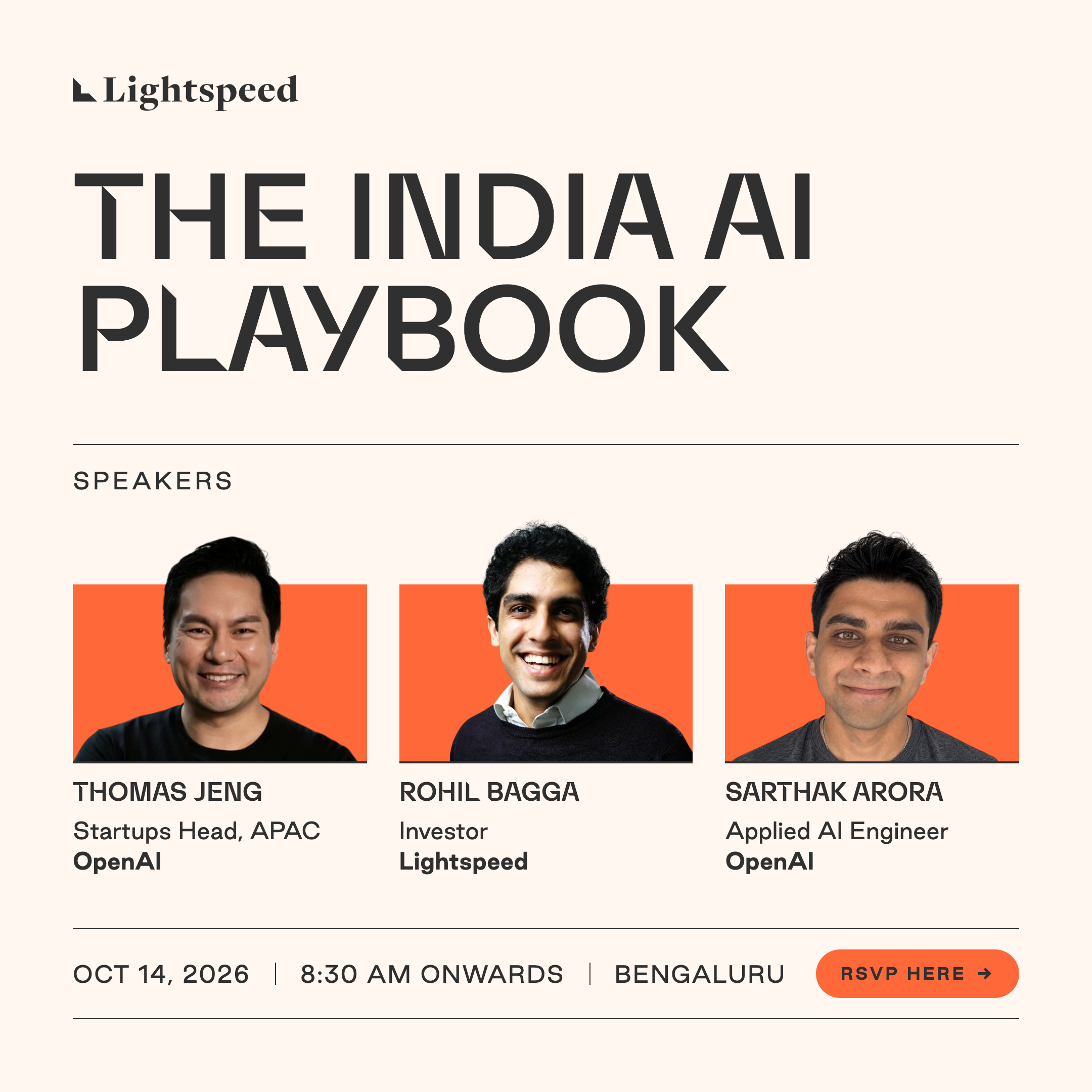
Lightspeed x OpenAI: The India AI Playbook
A breakfast session for AI founders and operators with Lightspeed India and OpenAI on shipping defensible AI-native companies from India.