Today’s lead · TechCrunch
AWS tries to make Trainium feel like a PyTorch default, not a port
AWS released TorchNeuron to move PyTorch workloads onto Trainium with a claimed one-line configuration change. The practical pitch is lower-friction escape from Nvidia CUDA, but the risk is more hidden configuration complexity if hardware-agnostic PyTorch stops being seamless.

Top signals
5 more
Microsoft reframes enterprise AI agents as insider-risk infrastructure
Microsoft added Guardian Agents and Defender controls after arguing enterprises should not trust frontier-model providers to police their own agents. The useful shift is treating agents like privileged insiders: discover them, constrain permissions, and require human approval when behavior turns risky.

OpenCode breach turns leaked AI API keys into a very concrete agent-risk lesson
OpenCode says a legacy Console breach may have exposed provider API keys for 1.4% of Console users, with some users reporting unauthorized AI spend. The incident also exposed an operational gap: defensive teams can hit model safety refusals while analyzing malicious code mid-attack.
OpenAI points its coding work at COBOL-era modernization, not just new apps
OpenAI says its latest model advances improve ChatGPT for low-resource programming languages, including COBOL, Fortran, and Visual Basic. For builders inside banks, governments, and legacy enterprises, the relevant promise is safer migration of old business logic, not another greenfield coding benchmark.
Gemini API adds cheaper long-form video understanding via selective media fetching
Google says long-form video analysis in the Gemini API is now more accurate and up to 66% cheaper. The mechanism matters: agentic video understanding uses tool calls to fetch only prompt-relevant media slices, which could make video agents less wasteful.
d3-turbo treats multimodal questions as decisions, not text generation
d3-turbo is a 26.09B multimodal decision model that answers choice, yes/no, score, box, and tracking questions with probabilities instead of generated text. Its most builder-relevant claim is StateOnce: read media once, answer many questions, and cut repeated vision work.
Tools & repos
4 selectedheadroomlabs-ai/headroom
Headroom compresses tool outputs, logs, files, and RAG chunks before they hit the LLM. The pitch is practical cost and context relief: fewer tokens for agents and JSON-heavy workflows while preserving answers.

Figma Specs
Figma Specs puts collaborative Markdown docs on or beside the canvas, with embedded frames, FigJam diagrams, comments, and MCP handoff to coding agents. Useful if design context keeps leaking across tools.

buddylist
buddylist wraps Claude Code, Codex, Gemini, and OpenCode in a desktop buddy-list interface. The interesting bit is orchestration: separate worktrees, shared folders, group chat, diffs, terminals, previews, and PR checks together.

Beam.win
Beam.win lets agents and builds keep running on one Mac while their Terminal, browser, and app windows appear on another Mac as native windows with Dock and ⌘Tab presence.
Blogs worth your time
3 reads
cuTile gets a real kernel workout on Mamba-2
NVIDIA and Jane Street walk through three cuTile Python kernels for Mamba-2 forward pass, then benchmark 1.14x to 1.82x kernel-level speedups over a Triton implementation on a single B300.
Modal’s Vera benchmark is really about sandbox contention
Modal benchmarked NVIDIA’s Arm-based Vera CPU on agentic Sandbox workloads and saw up to 2x throughput under heavy load. The takeaway: noisy multi-tenant agent sandboxes may care more about contention behavior than quiet-host latency.
Numan’s health coach case study is an eval design warning
Numan explains why static single-turn evals broke down for a regulated AI health coach. The useful pattern: test the production LangGraph, score per category, simulate conversations, and make clinician-owned rubrics gate safety claims.
Community discussions
2 threadsWhen AI makes research ideas cheap, experiments become the scarce resource
A researcher says AI now generates directions and smoke implementations faster than they can run, evaluate, and understand experiments. Commenters push the old truth back: ideas are abundant; execution, evidence, and taste are scarce.
Local LLM builders are still doing PCIe math to make dense models fit
A budget server builder wants Gemma 4 31B Q5 at 16K context and at least 15 t/s. The thread gets useful because someone shares real llama.cpp split-GPU numbers and PCIe transfer observations.
Funding & acquisitions
4 moves
Tenstorrent raises $1.5B to stay independent in the inference-chip fight
Tenstorrent raised $1.5 billion at a $6.2 billion valuation after reported acquisition interest from Intel and Qualcomm. The capital is aimed at scaling chips for open-weight AI model serving and video generation.
Greptile raises $50M Series B for AI code-review validation
Greptile says it raised a $50 million Series B led by Menlo Ventures at a $750 million valuation. The company claims its review-and-test layer handles more than 1% of GitHub PRs daily.

Town hits unicorn status four months after public launch
Town raised a $108 million Series B co-led by Forerunner Ventures and Menlo Ventures. Its bet is workplace AI assistants, called Townies, that connect to business tools and can share approved context with each other.

Hunar.AI raises Series A for multilingual frontline hiring agents
Bengaluru-based Hunar.AI raised about ₹40 crore in a Blume Ventures-led Series A. It builds conversational AI agents for frontline hiring, onboarding, training, and retention across regional languages.
Bengaluru radar
2 events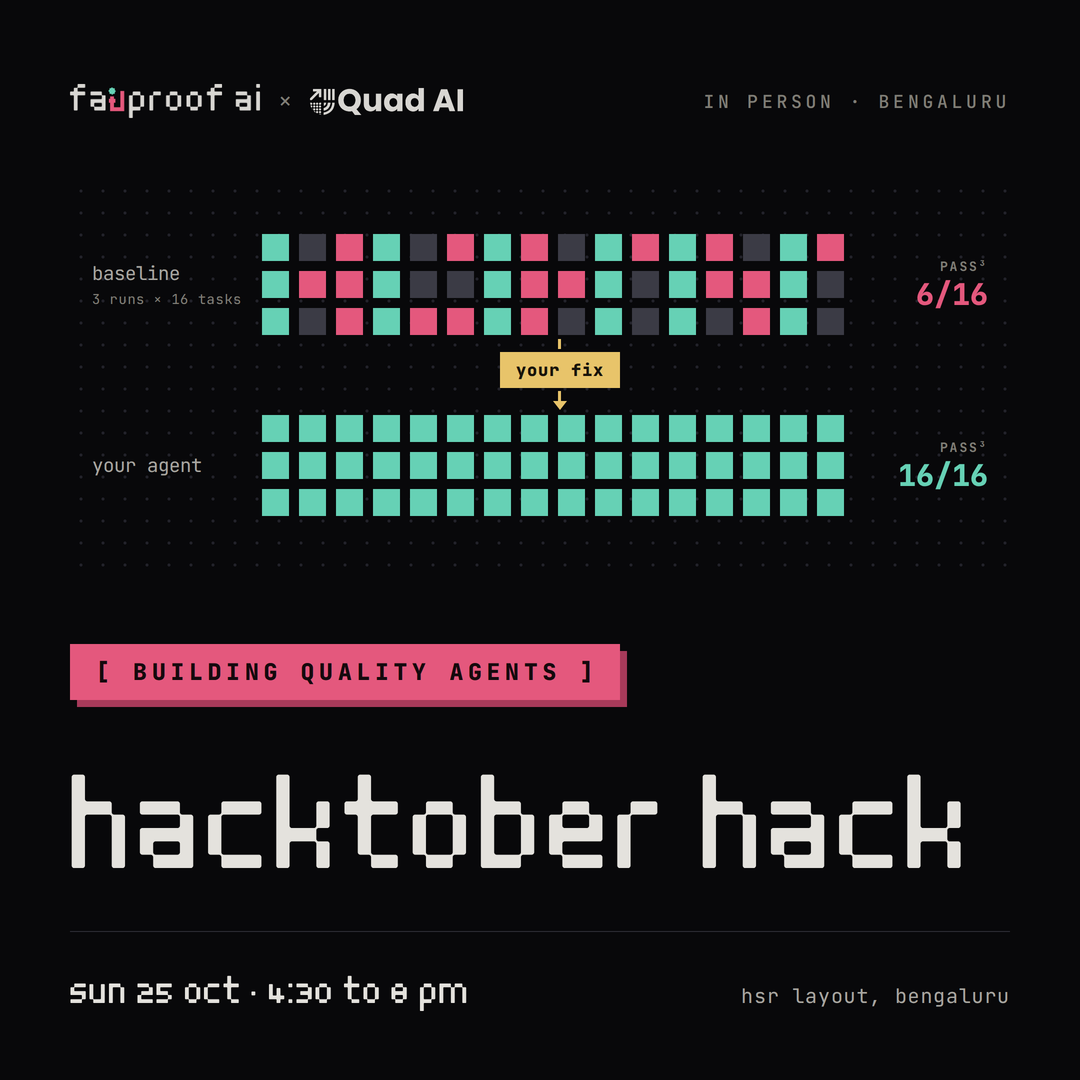
Hacktober Hack
A hands-on HSR hackathon on making a flaky open-source AI agent shippable using prompts, tools, validation, retries, guardrails, and evals.

RSI Research Mixer
A Bellandur research-led mixer for builders exploring recursive self-improvement, memory, RL environments, evaluations, verification, and long-running agent infrastructure.