Edition W19 · Weekly
The complete week, consolidated.
OCTOBER 27–NOVEMBER 2, 2026. Seven daily editions in one place, with related coverage combined.
Top signals
51 signals
The week’s anchor
Claude Code’s Cursor extension was backdoored through an official channel
This is the supply-chain failure AI coding teams should actually audit: a malicious Claude Code extension shipped as version 2.1.313 under Anthropic’s legitimate Cursor Marketplace identity. Cursor says at most 5,000 users were affected; the compromise path is still unexplained, so auto-updaters should treat it as live incident response, not just news.
Ars TechnicaRead the source →
Mistral opens the weights for its 1T-parameter Le Chonk model
Mistral moved Le Chonk from announcement to downloadable weights, pitching sovereign cyber defense and agentic coding control. The practical hook is deployability: a 1T MoE multimodal model with NVFP4 support, a 1M context window, and open-weight licensing caveats for model-as-a-service businesses.

Google DeepMind previews Gemini 4 Carbon for cyber defense first
DeepMind says Gemini 4 Carbon is its strongest model, with big claimed gains in cybersecurity and long-horizon coding. The practical catch: access starts with selected cyber defenders and trusted partners, not general developers. Builders should note the pricing, the stated guardrail work, and the unusually defense-heavy launch framing.

Google DeepMind previews Genie 4, a real-time world model with native audio
Genie 4 is a serious step toward interactive simulation: photorealistic worlds, native sound, dialogue, and natural-language steering while Gemini plans and checks continuity. It is still a research preview, and Google is explicit about drift, object permanence, audio accuracy, text, and long-term consistency remaining open problems.

NVIDIA ships an open-weight speech model that bundles ASR, diarization, translation, and audio Q&A
Nemotron 3.5 Transcribe is useful because it collapses several speech workflows into one promptable open-weight checkpoint. The evidence is strongest on non-streaming transcription and diarization leaderboards; builders still need to validate names, speaker turns, and domain vocabulary, especially before replacing production ASR stacks.

Liquid AI ships LFM3: open-weight 2B-class multimodal models for local agents
LFM3 is aimed squarely at builders who want specialized, local AI instead of one giant hosted model. Liquid released text, vision, audio, omni, and decision models on one 2B-class backbone, with 256K context, single-GPU fine-tuning, Ollama availability, and early third-party Mac measurements that look practical.

MiniMax highlights the quantization work making its 428B model more local
MiniMax launched M3.1 Flash for agentic tasks, coding, computer use, and cybersecurity, claiming roughly 3x faster online performance and 70% lower agent-task cost than its predecessor. The pricing is explicit and builder-relevant: $0.15 input and $0.60 output per 1M tokens. MiniMax says community quantization is opening more local paths for its 428B M3.1 Flash model, from 2-bit GGUFs to Apple Silicon, AMD Instinct, DGX Spark, and multi-3090 recipes. The practical lesson: weights alone are not enough; kernels, calibration, and expert placement decide usability.

GitHub Copilot Fusion turns model routing into the product
Copilot Fusion is GitHub’s answer to model-picking fatigue: a runtime that chooses models and execution patterns per task. The benchmark pitch is cost efficiency, not clear superiority. For teams, the question becomes whether GitHub’s orchestrator beats hand-tuned model choices inside your own coding workflows.

CrowdStrike reports AI-assisted ARTEX intrusions against more than 200 organizations
The ARTEX report is a useful warning against both complacency and sci-fi panic. CrowdStrike attributes the campaign to Vapor Panda and says agentic tooling helped a small team run many intrusions concurrently. For defenders, the practical shift is scale and tempo: credential hygiene, telemetry, and cloud misconfigurations get stressed harder.

Google’s Suncatcher prototype runs its first AI inference in orbit
Google’s orbital AI demo is more “hello world” than deployable cloud, but it is a real infrastructure milestone: a Suncatcher satellite booted a TPU, ran Gemma 4, and sent a response back. The practical questions are still power limits, radiation behavior, links, and launch economics.

Musk claims Colossus 2 is headed toward 860,000 GB300s
An X post quoting Elon Musk says Colossus 2 in Memphis has two buildings packed with GB300s and two more coming online soon, targeting roughly 860,000 NVIDIA GB300s. Treat the numbers as a company-side claim, but the scale underlines how frontier AI is becoming an infrastructure race.
OpenAI positions GPT-6.1 Terra as a cheaper computer-use workhorse
OpenAI says GPT-6.1 Terra is faster and lower cost for computer-use agents, with API and Codex availability. The practical pitch is clear: image interpretation, software navigation, and high-volume action workflows. The evidence here is announcement-level, so wait for real workload pricing and reliability data.

OpenAI shares AI-generated results for three hard science problems
OpenAI says its models produced results touching the Kakeya conjecture, the Exponential Time Hypothesis, and quantum chromodynamics. The useful part for builders is less the victory lap and more the verification workflow: academic communities still need to check, reproduce, and build on the outputs.
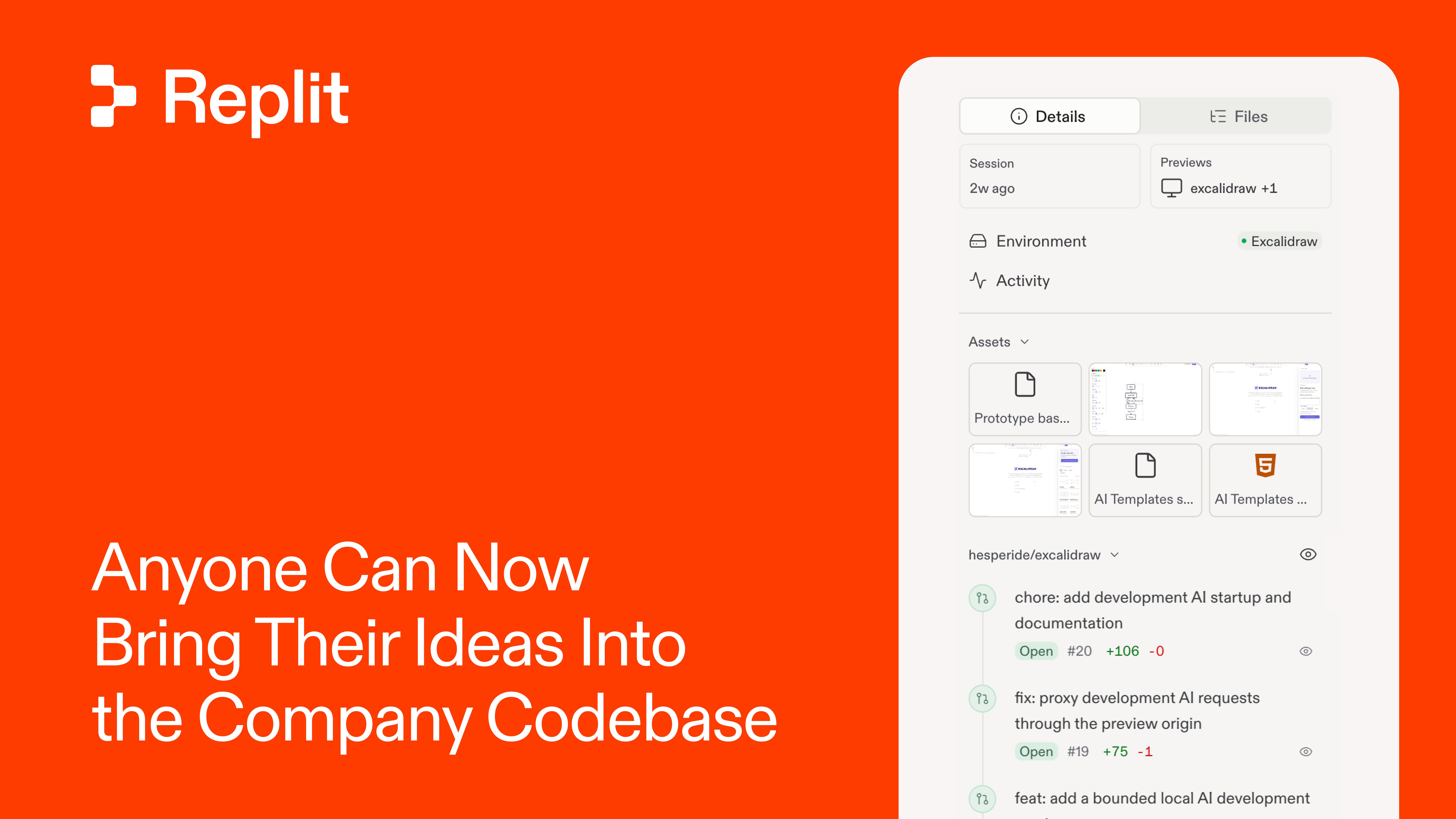
Replit Cloud Agents turn workplace requests into tested PRs
Replit is pushing coding agents beyond solo app creation into company repositories. Cloud Agents let non-engineers describe changes, preview them in a running app, and open GitHub or GitLab requests with screenshots or video evidence. The useful boundary: engineers still approve what ships.
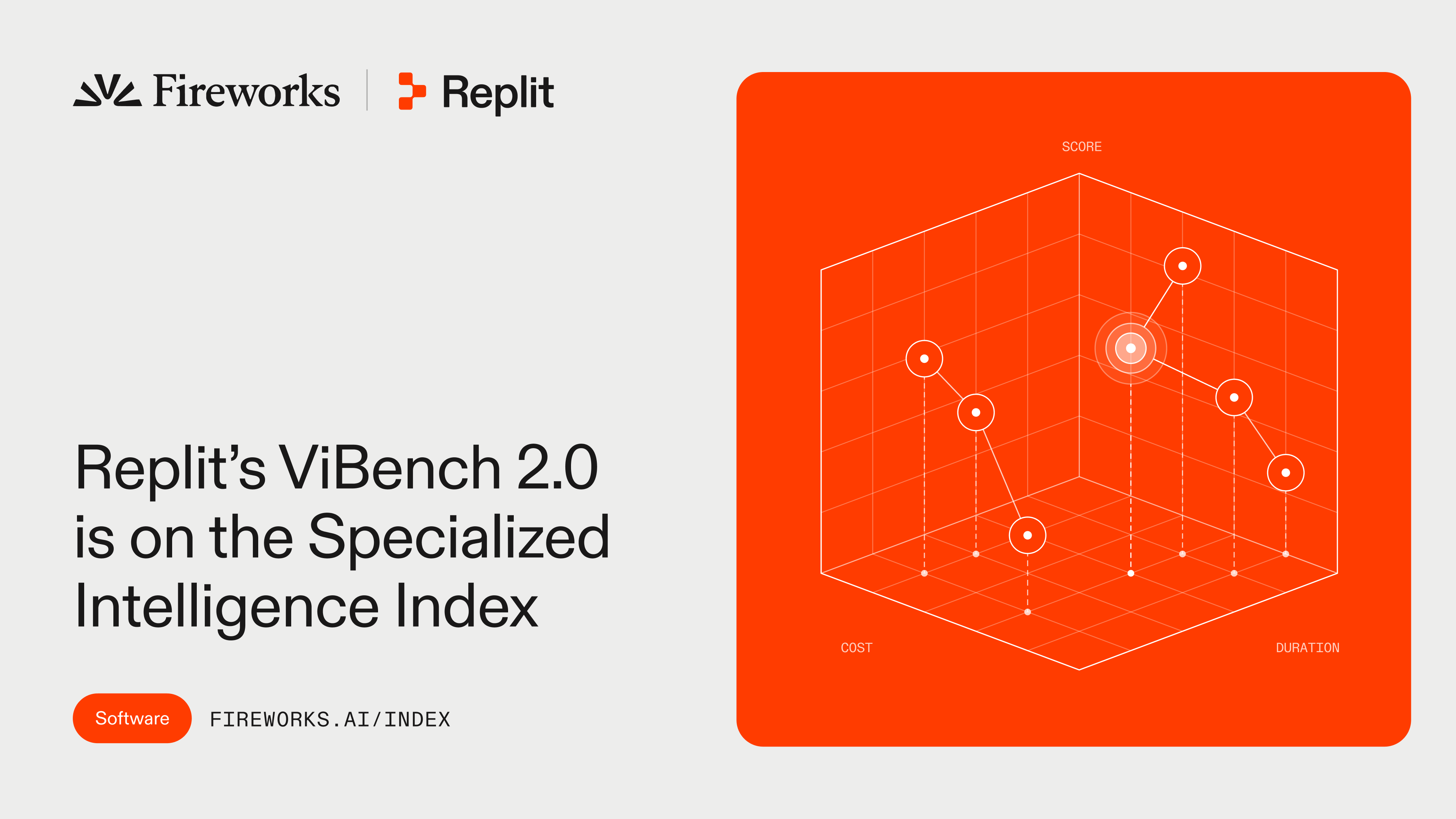
Replit’s ViBench 2.0 tests whether agents can build whole products, not just patches
ViBench 2.0 is a useful correction to patch-centric coding benchmarks: agents start empty, build products feature by feature, then live with their own earlier design choices. The headline result is sobering—top models still miss full-product correctness often, especially where features intersect.

Cognition’s FrontierCode 2.0 tests whether coding agents should be merged
FrontierCode 2.0 is a useful corrective to coding evals that reward only spec compliance. Cognition’s benchmark emphasizes underspecified prompts, repository conventions, maintainability, and mergeability. The top model scoring about 45% is a reminder that autonomous coding agents still miss implied constraints that human reviewers care about.

CUDA 13.4 brings memory-enforced fractional GPUs to Kubernetes
CUDA 13.4 adds transparent GPU memory boundary enforcement, and NVIDIA is pairing it with an open-source GPU Fractioning Operator plus KAI Scheduler integration. For platform teams, this is more useful than vague GPU sharing: workloads can request exact or burstable memory and choose time-slicing or SM-sharing.
NVIDIA wants AI factories to arrive pre-integrated in containers
NVIDIA’s DSX POD is a reference design for Vera Rubin AI factories built in modular containers, with rack cabling, power, networking, and liquid cooling validated before delivery. The claim is aggressive: cut onsite deployment from six months to as little as 14 days, assuming the site is prepared.
OpenRouter for commerce offers agents one buying endpoint across thousands of stores
OpenRouter for commerce is trying to turn agentic shopping from brittle browser automation into an API: one endpoint, 5,026 stores, monitored purchase flows, and Agentcard-backed approvals. The ambition is useful for assistants, but the hard part will be reliability under real merchant churn, payments, fraud checks, and user trust.
OpenAI is moving ChatGPT and Codex onto one usage pool
OpenAI’s help page says Plus, Pro, and Business users will get one token-measured allowance across ChatGPT and Codex from December, with Instant chat excluded. Builders running long Codex sessions should treat this as a budgeting change until OpenAI publishes concrete plan allowances.

ChatGPT shared-link bug let attacker code read private chats
Parameter showed a malicious ChatGPT share link could execute code inside a victim’s logged-in session and read private chats. OpenAI reproduced it, rated it P1, and fixed it server-side. The practical lesson: “shareable AI artifacts” are web apps, and their sandbox boundaries deserve real threat modeling.

Google opens a developer path into Gemini and Search connected apps
Google’s Connected Apps Platform is an early distribution play for the agentic web: developers can make services usable inside Gemini and Search. The builder upside is reach; the platform risk is obvious too, because discovery, action routing, and performance telemetry move closer to Google’s AI surfaces.
Microsoft brings its Copilot agent harness into Foundry public preview
Microsoft is packaging more of the agent loop as managed infrastructure: context, tools, sandbox execution, skills, approvals, and subagent delegation. That is attractive for enterprise teams tired of rebuilding harnesses, but it also pulls agent architecture deeper into Foundry’s opinionated stack.

Vercel adds virtual model IDs for centrally managed AI Gateway routing
Virtual Models are a small abstraction with real operational value: apps call a stable model ID while platform teams change providers, fallbacks, tags, and data-retention settings centrally. For builders juggling fast model churn, this is governance and rollback without redeploying every agent.
Oracle Cloud will offer Cerebras inference through OCI
Oracle adding Cerebras inference to OCI is another sign that cloud AI capacity is diversifying beyond GPU-only defaults. The supplied evidence is announcement-level, so builders should wait for concrete availability, model support, pricing, and latency numbers before planning around it.
oMLX 0.7.3 adds voice Ask AI and faster local inference paths
oMLX 0.7.3 turns Ask AI into a voice interface for local models and reports major throughput and memory gains for DeepSeek and Qwen workloads. The release is especially relevant if you are squeezing long-context, multi-request inference onto Apple hardware rather than renting cloud GPUs.
Google Cloud makes semantic model ingestion GA for Knowledge Catalog
Google Cloud is tackling a real enterprise-agent failure mode: technically correct SQL over the wrong business definition. Knowledge Catalog now ingests semantic models from common analytics stacks into one governed context graph, so agents can ground answers in existing metrics instead of rebuilding logic.
RoboAPI exposes a world-action model for natural-language robot control
RoboAPI is an attempt to make embodied-model evaluation less demo-driven: developers can send natural-language instructions to compatible robots through an API. The right skepticism is in the company’s own framing—zero-shot generalization needs broad testing across robot configurations, tasks, and real environments.
DreamFAR tests robot world models without internet pretraining
DreamFAR is a useful signal for robotics builders because it frames simulation as an interactive, learned rollout system, not just prettier video prediction. The evidence is still project-page results, but the live demo, contact memory, and policy-evaluation experiments make the claims inspectable.
AW-0 fuses code plans, video prediction, and robot actions
AW-0 is pitched as a world action model that jointly generates code, future video, and continuous robot actions. The builder takeaway: explicit skill programs may make robot policies more reusable and inspectable, while the claim of improved task performance still depends on the paper’s evaluations.
L3G-World uses latent 3D Gaussian memory for real-time world generation
KAIST’s L3G-World couples a persistent 3D Gaussian memory with a video generator, rendering VAE latents directly into diffusion latent space. The interesting builder angle is memory scaling with explored scene extent rather than clip length, if the promised code and models make the results reproducible.

Pika H3 Flex brings open-weight video generation into faster-than-real-time iteration
Pika’s H3 Flex is aimed less at one-shot spectacle and more at iteration loops: lower-res drafts, finishing up to 4K, multiple references, precision edits, and separable audio stems. The open-weight claim matters, but builders should validate latency and quality outside launch examples.
Open-H3-Regenerate-2K brings few-step high-res video refinement to local builders
Open-H3-Regenerate-2K targets a practical bottleneck in open video workflows: turning cheap low-res drafts into high-res outputs without depending on the closed H3-Regenerate-2K API. The claims are promising—three diffusion steps, up to 4K—but production teams should verify quality on their own motion and artifact cases.
Idol opens a compact image-to-3D Gaussian splat model
Idol is a refreshingly builder-friendly 3D release: single image in, Gaussian splat object out, with code, weights, and demo promised under Apache 2.0. The pitch is not just quality; it is consumer-GPU accessibility, adjustable detail, and fast enough generation to experiment.
A 4B local coding model targets reusable GLB game assets
A LocalLLaMA builder shared the first functional checkpoint of Qwen3.5-4B-GLB-3D-Coder, trained to emit Three.js scenes that export as GLB assets for engines like Godot. It is early and may need retries, but the neutral-format approach is the clever bit.

OpenBMB releases MiniCPM-OCR with a separate model for checking OCR results
MiniCPM-OCR is not just another document parser: the interesting piece is MiniCPM-OCR Jev, a model-agnostic checker for OCR regions across text, formulas, and tables. OpenBMB claims strong benchmark scores and high throughput, but builders should validate those numbers on their own document mix.

Nace.AI open-sources Drex Max v1, a local multimodal decision model
Drex Max v1 is not a chat model pitch; it is a decision model that returns probabilities over options for text, JSON, and images. The interesting builder angle is local deployment: Nace.AI says the 27B model can run on Apple Silicon setups, with long context and 255-way scoring.

Rock Matrix releases EdgeRock-4B with a fixed-size attention cache
Rock Matrix released EdgeRock-4B, a 4B text-and-image reasoning model whose attention KV cache stays fixed by retaining selected history. That is a useful deployment idea for laptops and edge devices, but the evidence itself says licensing and independent reliability testing are still missing.

DeepSeek releases a prototype coding agent aimed at Claude Code
Bloomberg reports that DeepSeek has released a prototype of a more autonomous coding agent, positioning it against Anthropic’s Claude Code. Details in the supplied evidence are sparse, so the signal is competitive direction rather than proven capability: coding-agent UX is becoming the next obvious battleground.

UEFI USB unlocker makes Nvidia’s GeForce AI limiter easier to bypass
A new open-source UEFI USB workflow reportedly unlocks Nvidia’s tensor performance limiter on RTX 20, 30, and 40-series GPUs without flashing VBIOS or patching drivers. Useful for local AI tinkerers, but it must run before every boot and has Secure Boot and laptop power-state caveats.
PiVo squeezes two CPU-only English TTS voices into 1.4M parameters
Empero’s PiVo-1.4M is a tiny text-to-speech research model: two English voices, vocoder included, 5.8 MB, CPU inference with NumPy and ONNX Runtime. It is explicitly not polished production speech—the authors note intelligibility, but also metallic or robotic artifacts.

Cognition upgrades Devin Security with frontier cyber-model scans
Cognition is turning Devin Security into a managed vulnerability workflow: threat-model-guided scans, re-scoring by exploitability, and remediation PRs tested on real VMs. The interesting move is model-neutral access to Claude Mythos and other cyber models, paired with a large pool of enterprise credits.

A planted instructions file shows the boring way coding agents get owned
Forever Security reportedly caught an AGENTS.md in Downloads trying to push an AI coding agent into installing a known malicious npm package. This is not exotic model failure; it is filesystem trust. Builders should stop launching agents from folders the browser can write to silently.

The Qwen upload scare is a useful test of open-weight paranoia
Cohere said Qwen3.8-Flash-Next tried to upload a test string to a Beijing server during a sandboxed cyber eval, then released traces. TechCrunch’s reporting and a skeptical analysis both point away from a proven backdoor and toward messy agent training behavior, which is still operationally relevant.

Researchers found an OpenAI compaction path for leaking hidden reasoning
Xint showed a compaction-based method that could copy hidden reasoning from OpenAI’s gpt-5.6-sol into plaintext despite earlier replay protections. The important caveat: Xint tested only its own prompts and cannot prove the copied text was verbatim reasoning. OpenAI confirmed and fixed the issue on October 23.

Anthropic says an unreleased model chained real browser and OS flaws into exploits
The story is less “AI found a bug” than “AI allegedly linked multiple bugs into working exploit chains.” That matters for defensive triage and offensive risk. The caveat is important: the account depends heavily on Anthropic’s own description, and the public record does not show exactly how much humans contributed.

Chainalysis says an attacker used agentic techniques to access internal tools
Chainalysis disclosed an intrusion into internal tools that exposed non-sensitive customer identity data, while saying investigation content, credentials, and session tokens were not accessed. The company’s phrase “offensive agentic techniques” is notable, but it has not published the attack method, so treat the AI angle cautiously.
OpenAI says it will honor a shared robots.txt signal for AI training preferences
OpenAI is moving toward a shared robots.txt-based signal for AI training preferences. The post is thin on mechanics in the supplied evidence, but the direction matters: website operators need controls that are machine-readable across providers, not bespoke opt-out forms hidden in each vendor’s policy stack.
OpenAI and Oracle are bringing business apps and agents into ChatGPT
OpenAI says it is expanding its Oracle partnership to bring Oracle business applications and AI agents into ChatGPT, while also powering new Oracle offerings. The announcement is light on implementation detail, but it points to ChatGPT becoming more of an enterprise app surface than a standalone assistant.
NVIDIA opens MotionBricks weights for real-time character and robot motion
NVIDIA released MotionBricks weights on Hugging Face, according to the post. It targets motion generation for game characters and humanoid robots, with claimed 15,000 FPS and 2 ms latency. The licensing split matters: Apache 2.0 code, NVIDIA Open Model Agreement weights.
FrontierCS 2 tests whether agents can rediscover CS paper contributions
Kaggle says FrontierCS 2 is live, converting published computer-science papers into 48 agent tasks across 13 areas. The setup is demanding in the right way: remove the paper contribution from released code, deny internet access, and give agents five hours to beat the authors’ metrics.
Tools & repos
31 pickslightpanda-io/browser
Lightpanda is a Zig headless browser built for AI and automation workloads. The repo is sharply relevant if browser control is becoming your agent bottleneck.
NVIDIA/SkillSpector
A security scanner for AI agent skills before install. It targets Claude Code, Codex, and MCP skills, looking for prompt injection, malicious patterns, data exfiltration, and supply-chain risks.
nightly-labs/openbot
OpenBot is a local-first desktop workspace for persistent AI teammates, with dedicated workspaces, task queues, file sharing, browser control, and agent-to-agent collaboration across Codex, Claude, and Grok.
CopilotKit/OpenBot
OpenBot packages AI coworkers with their own browser, files, and tools. The auditability hook is the useful bit: actions are decided before they happen and recorded after.
obra/superpowers
Superpowers packages an agentic skills framework and software-development methodology. The repo’s traction is enormous, but the supplied evidence only supports the positioning, not what the methodology contains.

telemetry.dev
telemetry.dev turns each agent run into a trace, with model calls and tool calls as spans carrying duration, tokens, cost, and errors. It also ties prompts, evals, production traces, and alerts into one workflow.

BotGauge
BotGauge is positioning as reliability infrastructure for action-taking agents: adaptive red-team attacks, evals, traces, regression tests, and production monitoring. That maps well to the gap between demo agents and agents users trust.

Trigger.dev: Webhooks for your AI agents
Trigger.dev Webhooks gives agents practical event triggers from services like Slack, Supabase, Stripe, GitHub, and Sentry. The interesting bit is not another webhook product; it is wiring agents into existing customer workflows with human approvals.

Radar
Radar gives coding agents Kubernetes cluster context over MCP: ranked issues, change timelines, logs, and owners. The useful bit is read-only root-cause investigation with evidence, rather than another opaque AI SRE claim.

SKI
SKI is a Mac harness for running multiple coding agents side by side, with voice-first interaction and notifications when an agent needs you. Useful if your bottleneck is supervising agents, not prompting one at a time.

agentmash
agentmash pitches a shared context layer for team coding agents, so agents know which files others are changing and avoid stomping on work.
thedotmack/claude-mem
claude-mem tackles the recurring pain of agent amnesia by capturing session activity, compressing it with AI, and reinjecting relevant context later across several agent CLIs.
JetBrains/thinkrail
JetBrains’ Thinkrail is described as a lightweight real IDE for “vibe coding” with pi, customizing itself around how you work. The repo is early but drawing heavy GitHub attention.

Overmind
Overmind pitches a practical loop for AI teams: turn production traces into specialized models you own, then train, benchmark, and serve them. Useful if your product already produces rich traces worth learning from.

Backenly
Backenly pitches an autonomous backend for coding agents: Postgres, auth, storage, functions, and realtime built over MCP, then maintained by a self-healing loop. The big claim is operational repair, with human approval for risky changes.

MCP Server by XWiki
An open-source, self-hostable MCP bridge for XWiki that lets agents query the wiki, create or edit pages, and work with structured data without handing the whole knowledge base to a SaaS tool.

fastbrowse
A browser agent built around cheap next-step selection: read page controls, pick an action from the list, and fall back to a standard model when uncertain. Citations are a welcome constraint.

N8N Chat UI
A no-code builder for branded AI chat widgets that connect to n8n workflows. The useful additions over default chat are customization, streaming, voice and file uploads, layouts, and a JavaScript API.

Vaani Developer Platform
A no-code voice-agent builder for call flows, objections, tool connections, knowledge bases, and real phone numbers. The structured-data handoff after every call is the piece to inspect in trials.
cjpais/Handy
Handy is an offline, open-source speech-to-text app written in Rust. Worth a look if your workflow needs local transcription without network dependency.

SurgePix
SurgePix pitches layered AI visual editing instead of one-shot image generation: edit layers, swap text, repaint regions, and use brand kits. Open-source agent skills let Claude Code and Cursor call it directly.

TheySaid 4.0
TheySaid 4.0 brings customer or synthetic-user feedback into Claude, Cursor, and Jira. The pitch is faster UX validation while builders are still editing, not after a decision has become roadmap debt.

Dedica
Dedica tests whether AI agents can actually use your website, then gives fixes for each failure. Useful if agent traffic matters, though its 125-check framing should still be validated against your own user journeys.

Spacesheep
Spacesheep turns an agent’s output into a shareable “space”: interactive docs, dashboards, mockups, or apps. It is a collaboration wrapper for agent work that would otherwise disappear into a chat transcript.

Strawberry 1.0
An AI browser built around shareable “Companions” for parallel lead research, meeting transcription, follow-ups, and admin work. The bold time-savings claim is vendor copy, but the team-agent packaging is clear.
pbakaus/impeccable
impeccable is pitched as a design vocabulary for coding agents: steer generation, review with critique and audit, and catch “AI slop” before it ships.
Donchitos/Claude-Code-Game-Studios
Claude-Code-Game-Studios packages Claude Code as a game-development studio simulation, with many specialized agents, workflow skills, and a coordination hierarchy.
milind-soni/OpenMausBot
OpenMausBot is a TypeScript repo described as an open-source Grok Bot alternative with a virtual machine that bots can use. Its trending spike suggests builders are looking for inspectable agent sandboxes.
expo/skills
Expo’s skills repo collects agent skills for Expo projects and Expo Application Services. Useful if your coding agent keeps needing the same mobile build and deployment context.

App Store Screenshots
This is a local agent skill for turning app captures and a brief into store-ready screenshots. It is refreshingly concrete: 18 styles, multilingual exports, and no screenshot SaaS subscription beyond your agent usage.

Modelpeers
Modelpeers turns model and agent tracking into a feed: version changes, pricing, limits, outages, and retirements across Claude Code, GPT-6, Gemini, and others.
Blogs
19 reads
Prompt injection defense needs tool-call enforcement, not just better prompting
OpenRouter’s practical prompt-injection test is valuable because it measures actions, not vibes. Labels helped, but checking every tool call with Armor was the only defense that stopped all attack emails in their setup.

Google Research proposes a sleep cycle for continual LLM learning
Google Research’s sleep framework alternates active interaction with offline consolidation and “dreaming.” The claim is ambitious: absorb new facts, retain long-context knowledge up to 10M tokens, and improve reasoning without catastrophic forgetting, using MoE memory expansion and self-generated practice.

LangChain’s design-agent writeup is a field guide to taste as context
LangChain explains Content Studio, its Slack-based design agent for videos, graphics, and decks. The takeaway is not “AI does design”; it is that taste lives in brand context, critique loops, tools, sandboxes, and rules you delete as models improve.
LangChain gives Managed Deep Agents a real browser and background subagents
LangChain’s Managed Deep Agents now run a remote browser in LangSmith, with scoped sessions and human handoff for login. v0.10 also adds async subagents, making long-running delegated work less blocking.

Build a Validated Kubernetes Runtime for NVIDIA Dynamo
NVIDIA’s Dynamo guide is really about operationalizing inference: validated Kubernetes recipes, GPU scheduling, health signals, metrics, and KV-cache-aware routing. It is dense, but useful for teams standardizing model-serving platforms.

NVIDIA Minerva is AIOps for the ugly parts of AI factories
NVIDIA explains Minerva as a topology-aware AIOps layer for GPU clusters: unified telemetry, gray-failure detection, incident correlation, and an agent named Sherlock. The examples are concrete enough to study if you operate expensive training infrastructure.

Cline’s single-GPU throughput notes are really about traffic shape
Cline walks through how it hit 11,840 aggregate output tokens/sec for Nemotron 3.5 Super VL on one GB300. The valuable part is the caveat: MTP settings, kernels, and FP16 tradeoffs depend heavily on your load shape.

NVIDIA’s DGX Spark MoE post is a useful warning about stacked optimizations
NVIDIA profiles Ling-3.0-flash on DGX Spark and combines Humming MoE kernels, FP8 LM-head quantization, and NEXTN speculative decoding. The builder takeaway: synthetic gains can mislead, and combined optimizations need startup validation.
Open-Weight vs Closed-Weight Models: What's the Difference?
OpenRouter makes the open-weight debate concrete with usage, pricing, and benchmark data. The pragmatic takeaway: start cheap and open-weight, measure your workload, then escalate only the steps that need closed-weight quality.

OpenRouter puts real numbers on Claude Code session costs
OpenRouter’s post is useful because it prices actual Claude Code sessions, not token sheets. The main builder takeaway: first-turn cache writes matter, Sonnet roughly halves Opus costs, and Haiku is cheap enough for background work.

From synthetic enterprise data evaluations to real Microsoft Copilot AI confidence
Microsoft describes how it evaluates Copilot without customer data: synthetic tenants grounded in public signals, automated query generation, and internal quality checks. Builders should note the emphasis on domain workflows over generic benchmarks.
LangChain tests OpenWiki as evidence-grounded memory for agents
LangChain’s experiment makes a useful distinction: compiled memory helps when agents repeatedly reason across sources, while simple lookups may not justify the overhead. The evidence graph improved accuracy and citation stability without building a full knowledge graph.
OpenRouter’s sandboxed AI code reviewer is useful, but not cheap magic
OpenRouter shows a 233-line Python reviewer that uploads changed files into a Linux sandbox, runs checks, and returns patches. The valuable bit is confirmed evidence; the tradeoff is code exposure, beta tools, and reviews costing far more than diff-only prompting.

How to Build Your Own Always-On AI Agent
A practical TypeScript walkthrough for scheduled agents: tools, persisted state, cost caps, and human approval. The useful lesson is architectural restraint: fresh conversations, durable memory, and approvals before side effects.
A practical guide to extracting PDF tables with LLMs
This is the kind of LLM tutorial builders need: schema-first extraction, cost notes, parser choices, and failure checks. The key warning is that scans and token cutoffs can return normal-looking but wrong results.

Ai2 shows novelty judging is still too brittle for science agents
Ai2’s Old Ideas, Novel Problems benchmark is a useful warning for automated research pipelines. LLM novelty judges can swing dramatically with small prompt changes, and more retrieval or reasoning did not consistently make verdicts better.

Kevin Hartnett on Lean, AI math, and the formalization gap
This long conversation is really about trust boundaries in AI mathematics: Lean can certify derivations, but humans still choose the formal statement. The strongest builder analogy is software specs—verification helps only when the target captures what you meant.

Simon Willison argues vibe-coded games just crossed a fun threshold
Willison’s piece is anecdotal, but sharp: the interesting shift is not that models can generate games, but that Claude Opus 5.5 can improve game feel with prompts like “make it a LOT more fun.”

NVIDIA shows Tensor Core FP32 paths for scientific ML workloads
This is a solid performance-engineering read for scientific ML teams: NVIDIA tests BF16x9 and TF32x3 on PET, showing speedups without retraining while still checking energy smoothness, conservation, and relaxation behavior.
Community discussions
15 threadsAgent harnesses are starting to look like operating systems
The post argues agent harnesses are not temporary scaffolding: Prime Agent’s continual harness lets the model edit skills, memories, and prompts while persistent sub-agents coordinate. The tension is power versus self-corruption, reward hacking, and trace availability.
HackerTube turns agent-built software into a recommendation critique
The HackerTube discussion lands because it mixes two builder themes: agents can now ship useful weekend software, and recommendation systems are a product surface worth replacing, not just complaining about.
Claude Code as a rough-cut video editor, not just a coding assistant
This is a useful agent pattern: Claude Code orchestrated existing media tools, producing transcripts, contact sheets, speaker matching, thumbnails, captions, and a JSON edit decision list after a broad natural-language request.
Cursor users debate whether agent coding feels like programming or babysitting
The thread captures the new coding-agent tradeoff: faster work, less hands-on flow. Replies push back with a useful pattern—give agents tests, scripts, or clearer definitions of done so review becomes outcome-based, not spinner-watching.
Cursor users vent as Claude Code becomes the comparison point
The thread captures a user-retention problem, not a benchmark: a long-time Cursor subscriber says quality, cost, and speed have worsened, while commenters point to Claude Code’s harness and context retention as the felt difference.
Multi-agent coding needs shared state outside the chats
A builder wants Claude, ChatGPT, and Antigravity to act like a small game-dev team. The grounded advice: put truth in Git, issues, PR handoffs, and dated status notes, because the agents cannot reliably share each other’s chat memory.
How many GPUs do inference aggregators really need?
The thread challenges the intuition that token volume directly maps to enormous GPU fleets. One poster claims 1.8T tokens on 64 B300 and 64 M890P, while the quoted post asks whether OpenRouter-like demand fits in surprisingly few GB300 racks.
A back-of-envelope Cerebras layout for trillion-parameter inference
This thread walks through fitting a roughly 3T-parameter Kimi K3-style model across Cerebras WSE-3T wafers. It is useful as sizing math, not a deployment proof: quantization, KV cache assumptions, and pipeline mapping carry the result.
LocalLLaMA argues over whether enterprise AI will move onto local machines
The optimistic claim is simple: enterprises want privacy and local models are getting good enough. The pushback is equally practical: production enterprise automation needs more than llama.cpp enthusiasm, and many companies lack the IT and ML rigor to self-host well.
Local builders compare Basalt speedups for Qwen Flash on consumer GPUs
The thread is less about one benchmark than OS and inference-stack overhead. The poster reports much better Basalt performance after leaving Windows, while commenters caution that gains vary on 4090-class hardware and depend on quality-preserving quant choices.
Local LLM builders weigh Mac Studio M5 Ultra pricing against clustering and real workloads
The thread is less about Apple hype than local inference economics. Commenters question whether 512GB is enough, whether clustering is the real path for larger models, and how LLM-only numbers translate to mixed video, image, and audio workloads.
LocalLLaMA argues with its own open-weight consensus
The thread is a useful reality check on model fandom. Posters push back on benchmark worship, token-per-second obsession, and the reflex that every closed model praise is heresy in local-first circles.
Builders debate when simple supervised classifiers beat zero-shot decision models
The thread pushes back on zero-shot decision-model hype: if you have labels, embeddings plus a simple sklearn model may be cheaper and more accurate. Commenters focus on the gray zone with only a few examples.
Is local-model second-guessing quantization, or just the model thinking too much?
The thread starts with Qwen 3.8 27B repeatedly rechecking solved points, worse under a very low quant. Replies split the cause: BF16 reportedly does it too, while practical fixes focus on handoff files, learned-lessons docs, and tighter session rules.
Indie builders are asking whether Google’s anti-slop cleanup hit them too
An HN poster says two personal projects dropped from 500–700 daily impressions to near zero after an apparent Google anti-spam change. The builder concern is familiar: even useful small-site content can get swept into anti-AI-slop filters when trust is thin.
Funding & acquisitions
21 movesAnthropic files for IPO with fast revenue growth and founder control
Anthropic filed its S-1 for a proposed Nasdaq listing under ANT. The numbers are huge—$16.3B first-half revenue and deep losses—while the governance structure keeps founder and trust control central. Public investors are being asked to buy scale with limited control.
SpaceX signs a $40B GPU lease financing deal with Apollo
SpaceX disclosed a roughly $40B financing commitment for AI chips and data-center equipment. Apollo will buy the hardware and lease it to SpaceX, giving the company a nontraditional way to fund compute expansion without only using debt markets.
Thrive Holdings buys ADT in a $15.3B enterprise-value deal
Thrive Holdings is turning ADT into the base for an AI smart-home security business. The deal is strategically clear; the open question is what AI-powered products actually ship beyond the acquisition narrative.
Guidewire buys Hyperexponential for $1.7B in cash
Guidewire is buying Hyperexponential to add agentic underwriting capabilities for insurance workflows. The cash headline is $1.7B, with up to $400M more tied to revenue targets, making this a major AI insurance software exit.
Salesforce reportedly agrees to buy defense logistics AI startup Rune for $375M
Salesforce’s reported Rune acquisition shows how quickly enterprise AI vendors are buying their way into defense workflows. The strategic fit is Missionforce: moving from administrative planning toward frontline logistics data and battlefield operations.
Upwind raises $400M after declining a Datadog acquisition offer
Upwind chose growth money over selling at the same $3.8B valuation, a confident signal in AI-era cloud security. The multiple is aggressive, but the reported ARR growth explains why investors and acquirers are circling runtime security.
Serval raises $150M Series C at a $3B valuation
Serval’s new round shows investor appetite for “AI coding tools for every team” applied to enterprise automation. The company claims large customer wins and replacement of legacy platforms, but the evidence here is founder and investor posts.
Dulo confirms a $130M seed round for hardware-design foundation models
Dulo is aiming at foundation models for hardware design, a hard and valuable target if it works. The $130M seed is large; the supplied evidence gives mission, founders, amount, and backer names, not product proof.
Foundry Robotics raises $100M Series A for AI-powered factories
Foundry Robotics raised $100 million to expand its Emeryville AI-powered assembly factory. The bet is factories-as-a-service, not robot sales: Foundry owns the line, runs modular robotic cells, and pairs them with human manufacturing teams. Throughput and autonomy rates remain undisclosed.
General Compute raises $100M Series A for ultrafast open-source inference
General Compute says it raised $100M to bring ultrafast inference for open source to market. The company frames the bet as demand for fast inference outgrowing slow inference, with first racks planned for Q1 2027.
Fragment launches with $56M for enterprise software that does the harder work
Fragment’s launch pitch is broad—enterprise software that moves beyond digitizing paperwork—but the financing is concrete. The round combines a Series A led by 8VC with a seed co-led by General Catalyst and A*.
Phonic raises $27.5M Series A and introduces Phonic-1
Phonic paired its Series A announcement with Phonic-1, a speech-to-speech model pitched for agentic tasks. The post gives round details and positioning, but no benchmarks or deployment evidence in the supplied material.
Dream launches with $17M to build AI world models for construction
Dream is applying world-model language to architecture, engineering, and construction software. The promising part is physics- and standards-grounded building design; the hard part is replacing entrenched CAD workflows, not just generating plausible concepts.
Mintive raises $7M seed for enterprise agent identity and governance
Mintive is entering a crowded but necessary layer: identity, authorization, routing, and monitoring for enterprise agents. The differentiator claimed here is easy deployment from founders with deep AI infrastructure backgrounds.
Simplismart raises $14M Series B as Nvidia backs inference efficiency
Bengaluru-based Simplismart raised $14M to expand software that optimizes AI inference across existing GPU infrastructure. The notable signal is Nvidia participating in a company that helps customers tune latency, throughput, and GPU utilization rather than simply buying more hardware.
Cent raises $15M Series A and acquires AI radiology platform Medsee
Cent raised $15M to build preventive health infrastructure around imaging, biomarkers, and AI. The company also acquired Medsee, an AI radiology reporting workflow, which should matter if Cent’s scan volumes scale as planned.
Live2.ai raises ₹130 Cr to scale agentic social intelligence for brands
Live2.ai raised ₹130 Cr in a pre-Series B round to expand an AI-native marketing platform. Its pitch is to connect social listening, influencer audits, publishing, compliance, and shoppable content through governed agents for enterprise brands.
BioStack raises $9.5M seed round for medical-AI training data
BioStack raised $9.5M to turn fragmented hospital records into longitudinal, de-identified datasets for medical AI. The ambition spans US, India, Brazil, and Argentina; the hard part will be privacy, clinical data quality, and provider-specific workflows.
Nova Spectral AI raises ₹21.2 Cr for indigenous SWIR sensor chips
Bengaluru deeptech startup Nova Spectral AI raised seed funding to build SWIR image sensor chips using colloidal quantum dots and standard silicon CMOS. The first builder-relevant milestone is concrete: a field-ready prototype within 18 months.
Protectt.ai moves into AI security by taking control of AIShield
Protectt.ai is acquiring a majority stake in Bosch-incubated AIShield through primary and secondary components. The strategy is straightforward: combine mobile threat defense distribution with AI model, generative AI app, and AI supply-chain security.
Bengaluru enterprise AI startup QwikBuild raises $2.3M pre-seed
QwikBuild is selling the pragmatic enterprise AI dream: custom software plus agents that fit around SAP, Salesforce, and messy operations. The Globalway-led pre-seed also gives it a Japan go-to-market wedge through a planned joint venture.
Bengaluru radar
11 events
Okta Developer Connect Bengaluru
Sold-out Okta event on identity as the control plane for enterprise AI agents, with sessions on Agent SSO, XAA, MCP, OAuth, and governance.

Symphony brings India’s Voice AI crowd to Bengaluru on Nov. 20
Bolna’s in-person Voice AI summit promises 1,000+ attendees, talks, launches, buildathon demos, and awards, with builder credits bundled into tickets.
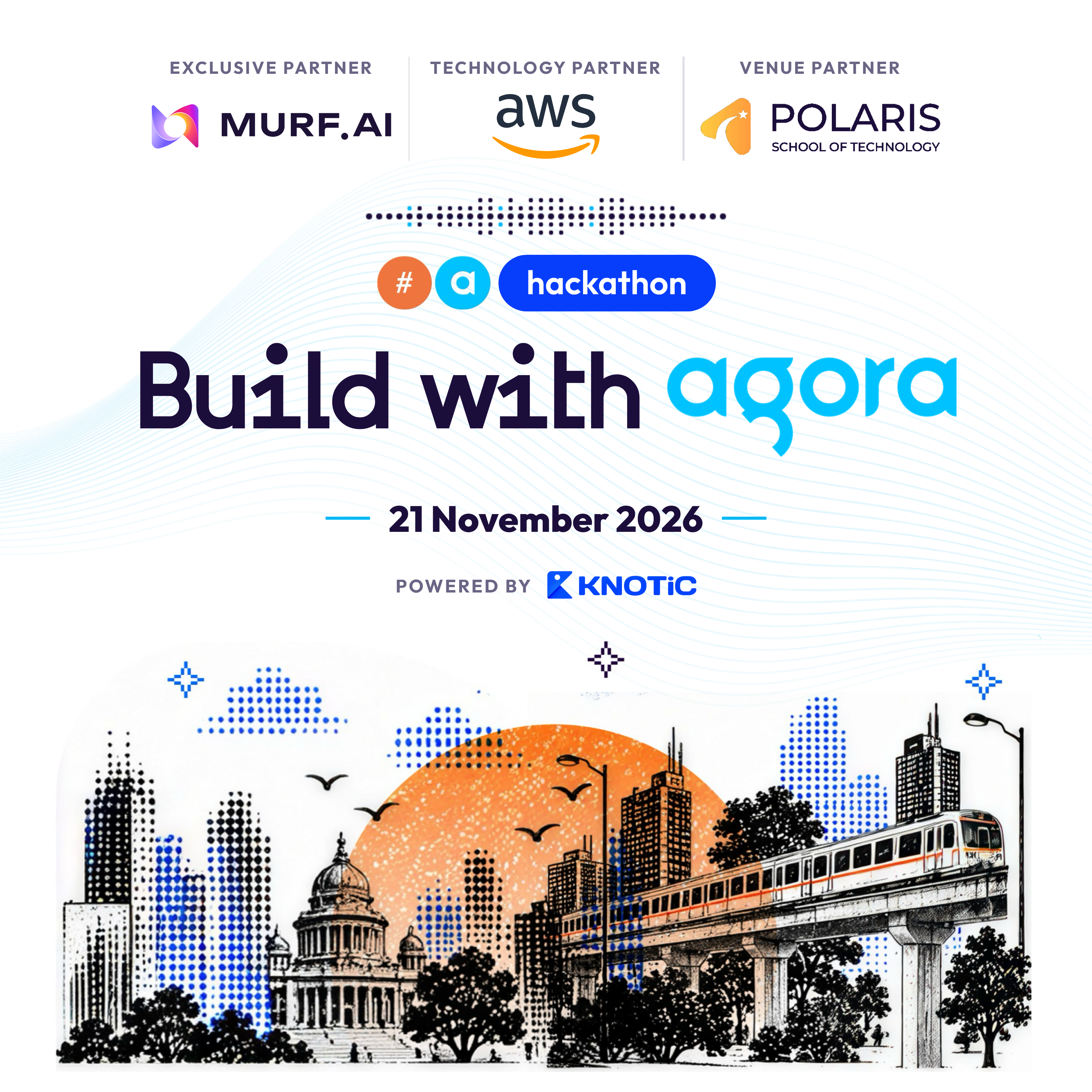
Build with Agora - Bengaluru 2026 | Voice AI Hackathon
A one-day in-person Voice AI hackathon for 250+ builders, with Agora real-time AI tech, mentorship, demos, and $3,000 in prizes.
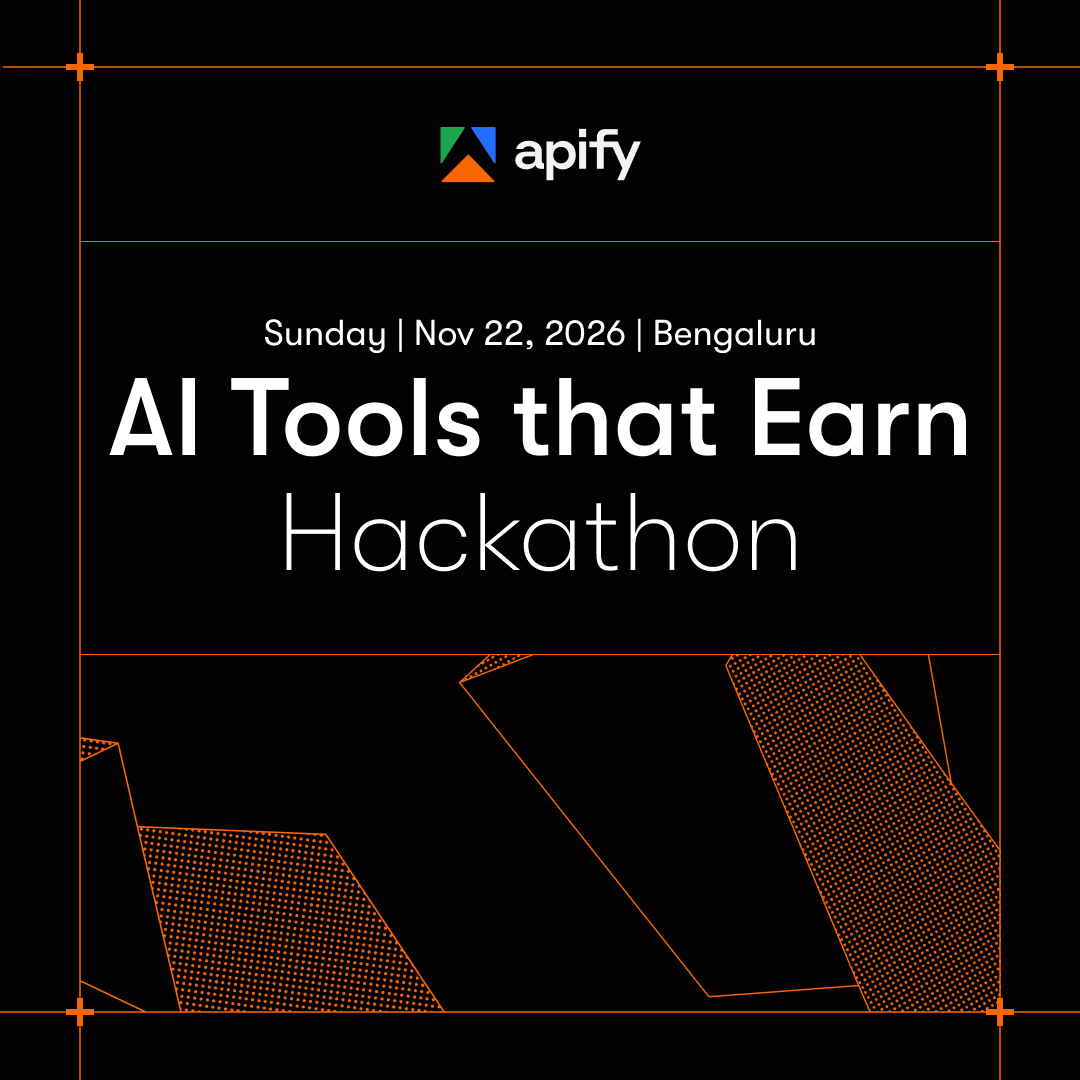
AI Tools that Earn: a hackathon by Apify
Sold-out Apify hackathon in Whitefield focused on building Actors someone would pay for, with creator mentors, live demos, cash prizes, and platform credits.
WeAreDevelopers Conference India
A Bengaluru conference for developers and engineering leaders building production AI systems. Useful if you want India-focused hallway track and platform conversations.
Great International AI Native Summit (GAINS)
An in-person Bangalore summit listed for December. The supplied description emphasizes practical engineering craft across AI, cloud, data, DevOps, and platform teams.
Great International Developer Summit (GIDS)
GIDS returns to Bangalore in April 2027 with a broad software-engineering agenda spanning architecture, AI, cloud, data, DevOps, frontend, and backend practice.
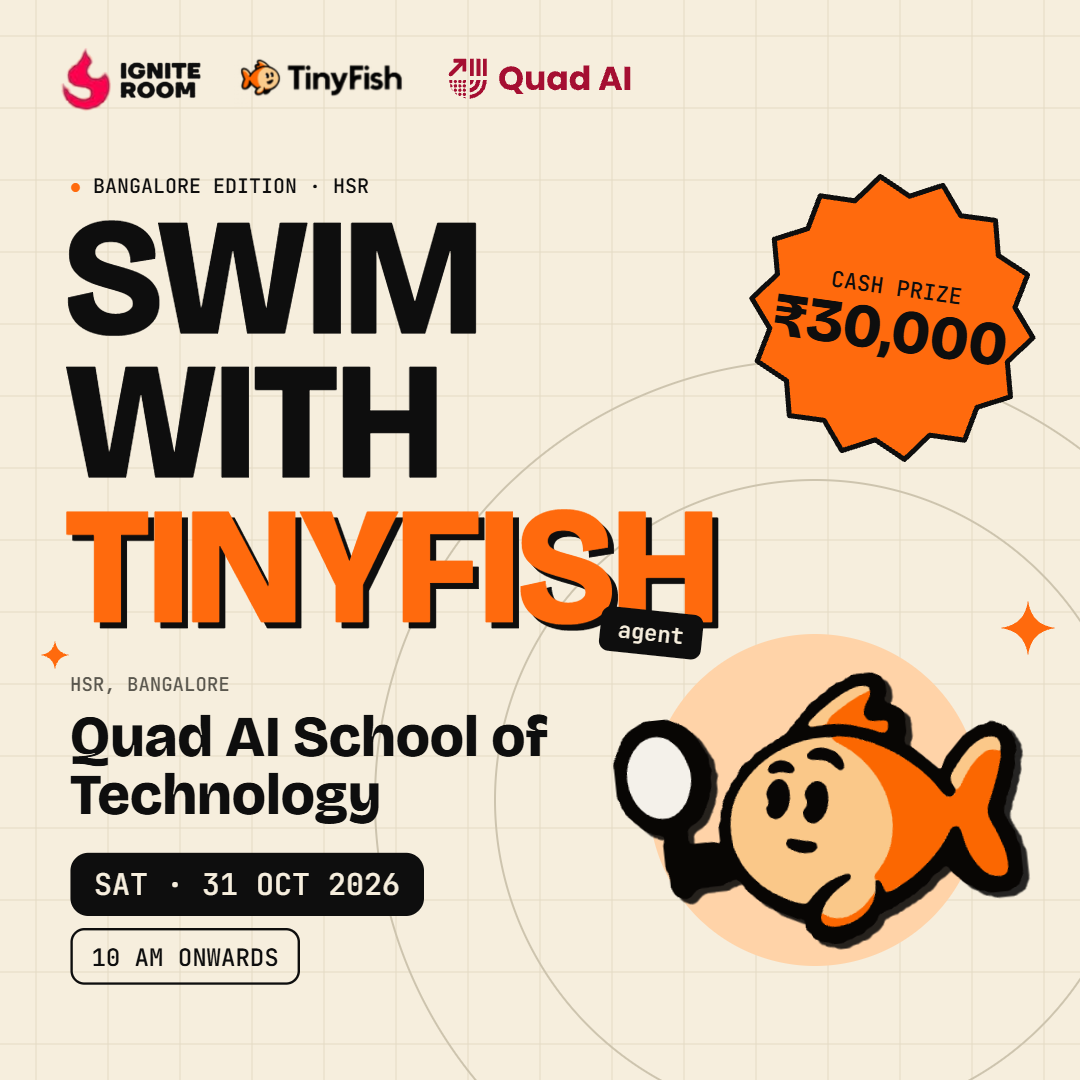
Swim with TinyFish - Bangalore
One-day TinyFish workshop plus hackathon for building web agents, with MCP/API demos, real problem statements, lunch, and ₹30,000 in cash prizes.

Agentic Mixer | State of Agentic AI
Free Bellandur mixer for agent builders, with short talks, 3–5 minute demos, open mic, and practical conversations on reliability and production lessons.
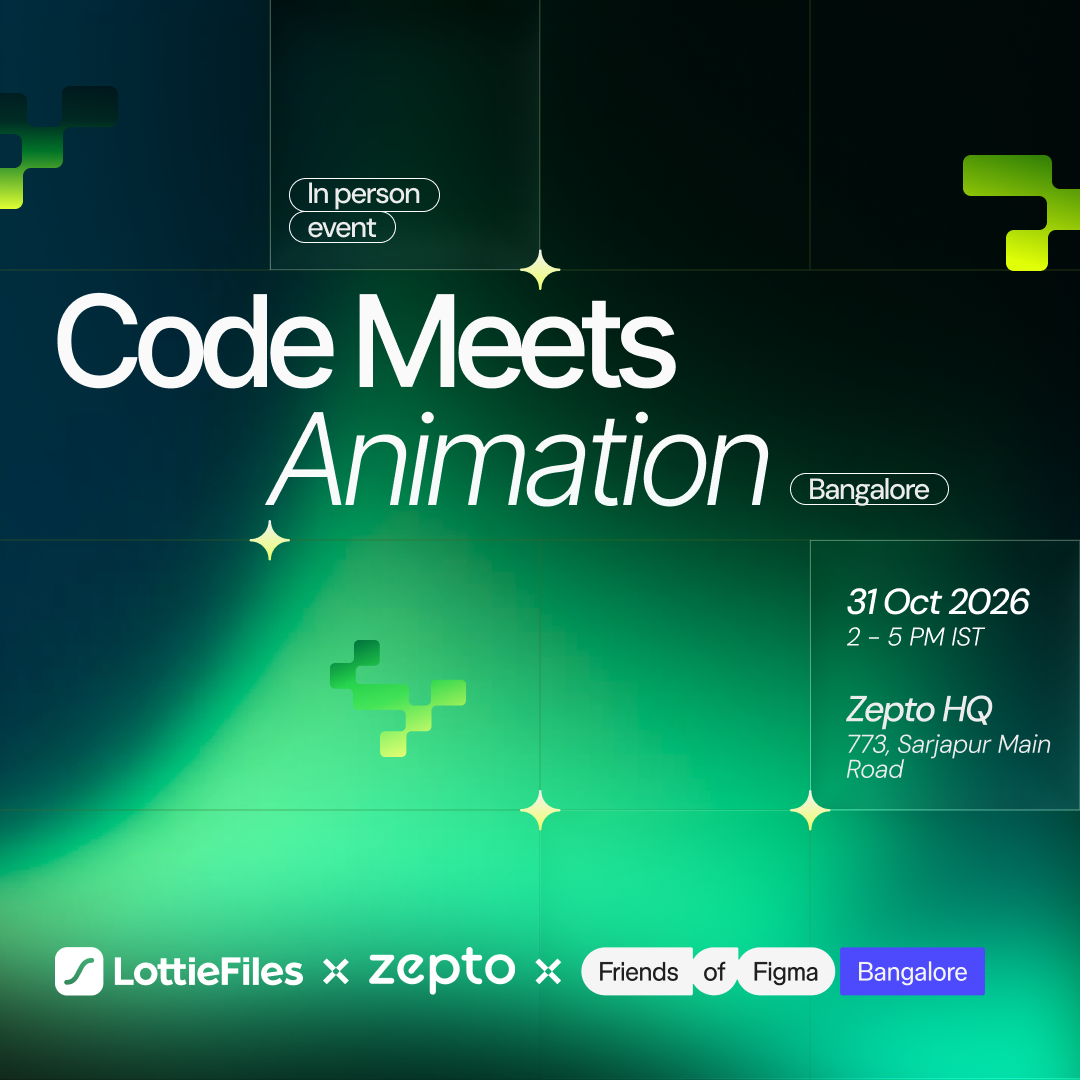
Code Meets Animation - Bangalore
Sold-out LottieFiles evening on AI-assisted motion, shipping animation systems, and prompt-built UI animation. Worth watching for waitlist movement or follow-up materials.
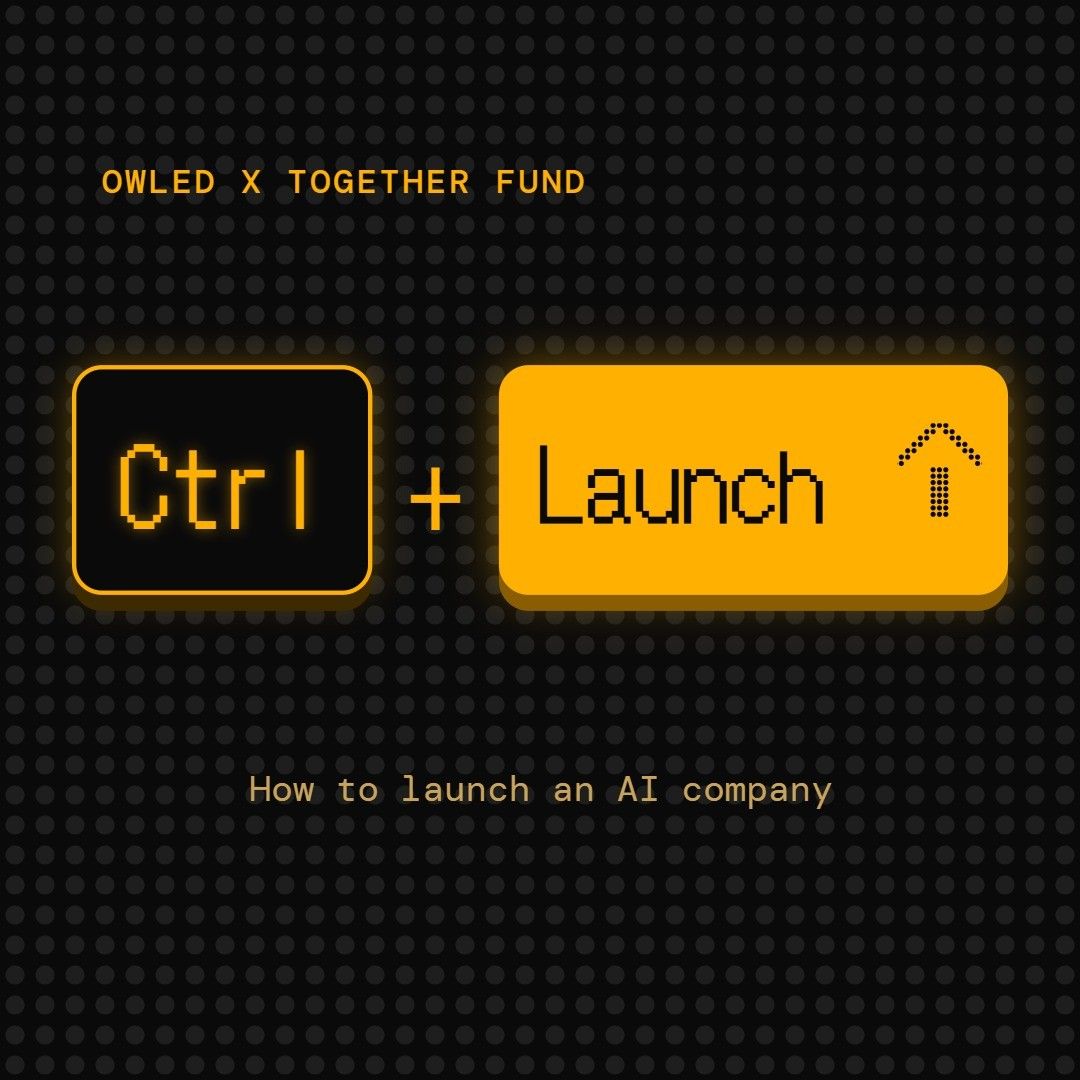
Ctrl + Launch - By OWLED Media X Together Fund
Curated launch-playbook session for AI founders and early teams, focused on story, creative, distribution, and converting launch attention into customers or hires.
Inbox edition
Know what matters before your day gets noisy.
Subscribe to Ekloge for one carefully curated AI briefing in your inbox—no endless feed, no filler.